Corporate Law Principles on Trial

(First appeared in Vietnamese in The Saigon Times, print edition on 15 April 2021, and online edition on 17 April 2021.)

This article reviews two recent court rulings on disputes among company members, raising concerns about how judges applied certain fundamental principles of corporate law. It should be noted that the author has not had access to the case files; thus, the assessment is primarily based on information reported by the media.

From the Case of Dau Tieng Lake Forest Mr. Tùng was the sole owner of a company in Tây Ninh, which primarily engaged in forest planting and care. In 2014, he entered into an agreement with Ms. Hồng for her to invest capital into the company. Ultimately, neither party contributed the agreed capital fully, though Ms. Hồng did invest over ten billion VND in actual cash. As a result, both parties sued to annul each other’s company membership. The People’s Court of Tây Ninh ruled in favor of Ms. Hồng. The High People’s Court in Ho Chi Minh City appellate hearing declared the capital contribution agreement invalid due to its fraudulent nature (the form being a capital contribution agreement but the substance being a project transfer), reversing the outcome in favor of Mr. Tùng.

In approaching and resolving the issue this way, the Court seemed to overlook several fundamental principles of corporate law:

  1. The Right of the Company to Raise Additional Capital: This right has existed in all three versions of the Enterprise Law over the past decade. When a company lacks capital, it seeks additional funding to enable project execution, prevent land from lying fallow, and ensure continued existence and development. Investors who have money can seize opportunities, while those with less capital can leverage others’ money to conduct business. By ruling as the Court did, it may have deprived the company of this right, sided with the defaulting party, and harmed the common interest.
  2. The Legal Status of the Entity: It appears that the Court only saw Mr. Tùng and Ms. Hồng as individuals who contributed capital to the company without recognizing the company’s independent existence, separate assets, responsibility to creditors, and capacity to be sued and to sue. If the forest planting project was acknowledged as Mr. Tùng’s contribution, it must belong to the company. As it belongs to the company, Mr. Tùng would not have the authority to transfer it. Furthermore, in the capital contribution relationship with Ms. Hồng, the company was the entity receiving the capital contribution. Within the company, Mr. Tùng had the authority to make decisions regarding the acceptance of capital contributions. In external relations, Mr. Tùng was the legal representative of the company at that time. However, according to the law, the transaction of receiving and contributing capital is essentially between the company and Ms. Hồng, giving rise to rights and obligations between the company and Ms. Hồng. In this case, Mr. Tùng and the company should not be conflated.

Regarding the author’s observation, the concept of the legal status of the entity in Vietnam seems to exist only in theory. The judiciary appears to consider the individuals who contributed capital to the company, especially the initial and largest contributors, as the company itself. Perhaps for this reason, using the above case as an example, the company’s right to raise capital and the right of subsequent contributors like Ms. Hồng have not been respected.

  1. The Right to Transfer a Project: This right is entirely different from the right to raise capital and the right to transfer shares or capital contributions. The right to transfer a project may be restricted under certain circumstances by civil, investment, land, and specialized laws. However, if the enterprise law does not prohibit capital raising and capital transfer rights, exercising these rights is legal.

Regarding the Case Involving the Owner of Sunwah Pearl

Bay Water Company has two members: Sun Wah and SATO, holding ownership stakes of 90% and 10%, respectively. In 2016, the charter of the company was approved, clearly stating that any amendments to the charter require the approval of all members. In 2019, the representative of Sun Wah requested an amendment to the charter to remove the requirement for unanimous voting. Despite SATO’s disagreement, the board of members of Bay Water passed a resolution amending the charter with only Sun Wah’s approval.

SATO sued to annul the resolution and won at the trial court. The High People’s Court in Ho Chi Minh City overturned the decision on appeal, accepting the amendment. By doing so, the Court seemed to overlook the principle of “freedom of contract” under corporate law, which allows a company’s charter to stipulate different provisions from the law in many cases. Setting a minimum voting threshold (100%) higher than the law default (at least 75%) as in this case is a typical example.

The purpose of these open regulations is for the law to protect minor capital contributors to the extent possible. Those who contribute more capital generally have more power. However, the law aims for fairness by requiring a higher consensus level for extremely important decisions than a usual level of more than half. The law also allows parties to agree and state higher thresholds in the charter than the minimum law default, even the maximum level. In this way, the law facilitates parties “tailoring the rules to suit.” Thus, even very minor capital contributors are protected, avoiding oppression by the other party. Using this way, the law encourages people to contribute capital, regardless of the amount, for business purposes.

Why do minor capital contributors need such high thresholds? Consider the specific example of a decision to increase company capital. If the charter does not stipulate that a capital increase decision requires the approval of a minor capital contributor, a major capital contributor (usually with more voting power) could continuously propose and implement capital increases. Those who can contribute more capital themselves or invite others to contribute. As a result, minor capital contributors, if not “deep-pocketed,” will eventually see their ownership percentage diluted and devalued. Similar to two partners making a cake, one contributes flour and the other contributes sugar. If the other continuously adds more flour, the sugar will become diluted even if the cake gets bigger. Foreseeing this, the sugar contributor initially demanded that the flour could only be added with their consent. Why would the flour contributor, even if provided with expensive flour, agree to this? Perhaps the sugar contributor had something valuable to offer in return, like baking skills, an oven, or access to electricity. Similarly, the major capital contributor might accept high thresholds, effectively “tying their hands and legs” because the minor capital contributor has something the major capital contributor needs to trade for, such as land, high technology, or even connections.

Once they have veto power, the charter becomes the “amulet” of the minor capital contributor. Therefore, they would also demand that any amendments to the charter require a high approval rate, to the extent that they have veto power. Otherwise, the other party could easily tear up the amulet before the minor capital contributor has a chance to use it. Returning to the case above, by recognizing the amendment resolution passed without the unanimous agreement of all company members, the court supported Sun Wah in tearing up SATO’s amulet. In doing so, the court seems to have disregarded the law.

What Will Happen Then?

Several years ago, the judiciary raised the issue of whether the right to contribute capital or purchase shares was a statutory right or required registration. Since then, according to the author’s observation, capital contributions and share purchases have continued without needing to register a separate business sector of the buyer. Similarly, after the court’s judgment in the Dau Tieng Lake forest case, people have still raised additional capital or transferred capital as usual, especially in the real estate field. It seems that even after the Sun Wah case, people will continue to draft charters granting veto rights to minor capital contributors. They do so because they rely on the law to protect themselves. However, this trend may change if more court judgments appear to contradict the fundamental principles of enterprise law.

Deeper into these cases lies the nature of contractual agreements. Historically, people initially engaged in transactions based on genuine trust. From trust came promises. But promises are often easily forgotten, so to ensure peace of mind, people need the power of the state to compel the promisor to fulfill their obligations or be held accountable for breaking them. Promises become contracts. Saying a contract is effective means the promisee can rely on the state, through the courts and enforcement agencies, to compel the other party to keep their word. Transactions, therefore, continuously occur. But when state power is abused, whether through intentional or unintentional misapplication of the law, contracts become meaningless, promises are as fleeting as the wind, and trust gradually erodes. So, on what basis can people purchase, conduct business, or cooperate?

By Ngu Truong 

On the Case of Shark Lien’s Company Being Sued: A Discussion on M&A

(First appeared in Vietnamese in The Saigon Times, print edition on 14 October 2021, and online edition on 16 October 2021.)

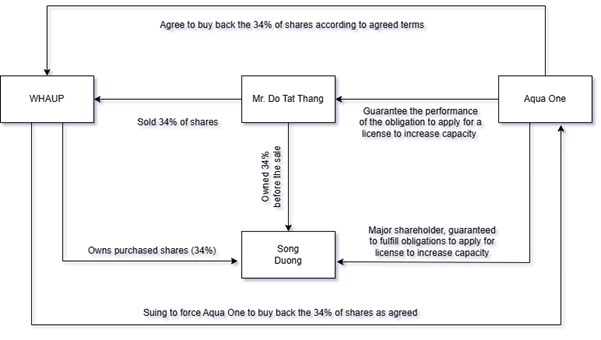
As reported by Saigon Economic Online, a Thai investor recently sued Aqua One (a company associated with Mrs. Do Thi Kim Lien, who is the Chairwoman of the Board of Directors) and Mr. Do Tat Thang at the Vietnam International Arbitration Center regarding the purchase of shares in Duong River Surface Water JSC (Song Duong) (1).

Based on publicly available information (2), this article briefly discusses several issues related to this specific case and the general practice of mergers and acquisitions (M&A) in Vietnam.

Mitigating Risks Through Contracts

In October 2019, the Thai party purchased a 34% stake in Song Duong from Mr. Do Tat Thang (who directly owned shares in Song Duong). According to the contract, if by October 25, 2020, Song Duong had not obtained the investment certificate to increase the capacity of the Duong River Surface Water Plant from 300,000 to 600,000 cubic meters per day, Aqua One (a major shareholder of Song Duong and the guarantor for Mr. Thang) had to buy back all those shares from the Thai party. In November 2020, the Thai party requested Aqua One to fulfill this obligation by June 7, 2021. Since Aqua One has not repurchased the shares, the Thai party has initiated arbitration proceedings.

From my experience, the Thai party’s commercial purpose in buying the shares was for the Duong River Surface Water Plant project to be implemented with double the capacity. Therefore, the risk for the Thai party when deciding to buy was that Song Duong would not be granted permission to increase capacity to that level.

There are at least two ways they could mitigate this risk. One is to require Song Duong to obtain the permit before they pay (all or most of) the purchase price. The second way is to accept the payment and set a deadline for Song Duong to obtain approval for the increased capacity. If the permit is not obtained by that deadline, someone will have to buy back the shares from them.

Here, the Thai party chose the second method, although the first method is more secure. They had reasons to do so, such as believing that with Mrs. Lien’s connections, obtaining the permit would be easy. Or they accepted the risk in exchange for a lower purchase price or to secure the contract from other potential buyers at that time.

Anyway, it was a commercial calculation; the important thing is that they recognized and mitigated the risk through the contract. The party required to buy back the shares could be the seller (Mr. Thang) or someone with greater financial capability (Aqua One). The Thai party might also have retained part of the purchase price, possibly in a jointly managed bank account.

Let’s talk about Commercial Law

The price Aqua One must pay to repurchase the shares is the amount the Thai party paid plus a sum referred to as the “Carrying Cost.” It is unclear how this additional amount is determined, but it likely includes interest calculated at a certain rate on the amount the Thai party paid.

Does this additional payment fall under the 8% limit on the value of the breached contract obligation? The answer should be: No. The share repurchase agreement creates a conditional obligation. Accordingly, Aqua One is obliged to buy the shares at a certain price and time, provided Song Duong does not obtain the permit by the agreed deadline.

Failure to obtain the permit is not a contract breach. It is an event that triggers the repurchase obligation. This agreement between the parties complies with Article 284 and related provisions of the Civil Code.

In fact, the entire Commercial Law should not be applied to share purchase agreements. The reason is that this law primarily governs contracts for the sale of goods and the provision of services. Shares are neither good nor services. Therefore, applying this law’s provisions (such as delivery, warranty, and transportation) to share purchase agreements would be inappropriate.

Conversely, the common terms of share purchase agreements, even if localized from Western contract templates, can be compatible with the general provisions of the Civil Code (3).

Hesitant Steps

Recently, the Science and Life newspaper of the Vietnam Union of Science and Technology Associations published an article stating: “After only two years of cooperation, Thailand’s WHAUP Company ‘retreated’ from the Duong River Surface Water Plant project. In fact, the plan to increase the plant’s capacity was ‘interrupted’ amid numerous controversies, and the senior leadership of Hanoi in the previous term all lost their positions”(4). If what the article says is true, it highlights another business deal that failed when officials were “ousted.”

Land, public assets, infrastructure, public services, and resources are all limited. Permits for projects in these areas are therefore scarce, difficult to obtain, and thus more expensive. It is not unusual for foreign investors to rely on, associate with, or cooperate with rising local entrepreneurs to obtain permits. But we can draw a few conclusions from this phenomenon.

First, if the amount foreign investors pay is significantly higher than the intrinsic value of the business just to get permits faster, easier, or with more privileges, they will later use every means to recover that excess amount. This is understandable at first glance because business needs to be profitable.

That’s true, but when privatizing public services, investors may aim to recover capital as quickly as possible, often not by improving quality but by raising prices, reducing actual capacity, or limiting quality. Consequently, the public, already with few choices in using public services, ultimately bears the burden of the large amounts’ investors pay. Hence the saying: public resources are enjoyed by private entities, while the people bear the cost.

Second, foreign investors will look at cases like this to assess the risk of investing in Vietnam, especially in the aforementioned areas. They may still invest, taking a high-risk, high-reward approach or perhaps with objectives other than profit. But legitimate investors from countries with a tradition of adhering to the law might hesitate and reconsider.

By Ngu Truong

—————–

(1) Van Phong, “Thai Company Takes Shark Lien’s Water Business to Arbitration” (October 7, 2021) (2) Including WHA Group’s letter to the Chairman of the Thai Stock Exchange, dated September 30, 2021, announcing the initiation of arbitration proceedings in Vietnam, https://www.set.or.th/set/pdfnews.do?newsId=16329590281810&sequence=2021106612 (accessed October 10, 2021). (3) On this issue, the author provides detailed commentary in the book “Essentials of M&A Legal Practice” published by Thai Ha in cooperation with Industry and Trade Publishing House at the end of 2018 (reprinted). (4) Minh Quang, “Duong River Surface Water Plant’s Expansion Plan Stalled, Investor ‘Withdraws'”, https://khoahocdoisong.vn/lo-nhip-quy-hoach-nha-may-nuoc-mat-song-duong-nha-dau-tu-thao-chay-181292.html (accessed October 10, 2021).

Law on Economic Concentration: Three Years After Grab Acquired Uber

(First appeared in Vietnamese in The Saigon Times on 20 November 2022.)

(SE) – Editorial Note: Recently, the Vietnam Business Lawyers Club (VBLC) held a specialized workshop on the key aspects of evaluating an M&A transaction for “Substantially Lessening Competition: Theory and Practice,” with the main presentation by Lawyer Truong Huu Ngu. The Saigon Times discussed the issues raised at the workshop with lawyer Ngu.

The workshop focused on evaluating whether an economic concentration transaction (M&A) significantly lessens competition. This criterion is set by the revised Vietnamese Competition Law, effective from 2019, to determine whether such M&A transactions should be prohibited. Recently, it seems we have mainly discussed regulations related to the notification procedure for economic concentration.

SE: Briefly, what is the criterion of “substantial lessening of competition”?

– Lawyer Truong Huu Ngu: This criterion is used in many countries’ competition laws to control M&A transactions. Generally, competition authorities compare the level of competition in the market in two scenarios: if the M&A transaction is executed and if it is not. If the level of competition in the first scenario is significantly lower than in the second, the M&A transaction may be prohibited.

SE: How can we “measure” the level of competition in the market to make this comparison?

– There are certain principles to do that. In many countries, the written law only acknowledges the criterion of “substantial lessening of competition,” while how to apply it, what factors to evaluate, and how to assess them are developed from the practical application of this criterion by competition authorities for specific cases and court decisions.

Over time, these principles are documented in merger guidelines issued by competition authorities.

SE: Does Vietnam have such principles?

– Until now, we have only recognized very general principles in the Competition Law (Article 31) and Decree 35/2020 (Article 15). As I understand, the Vietnam Competition and Consumer Protection Authority (VCCA) is working on detailed guidelines.

SE: Can you briefly and clearly describe how an M&A transaction might be analyzed to assess its impact on market competition?

– To keep it simple, let’s imagine an M&A transaction between two companies that are currently competitors.

The concern of competition authorities is that after the transaction, these two companies, now as one (in terms of capital ownership and management, even if they still have independent legal statuses), will no longer compete with each other. Additionally, the combined company (referred to in law as the “post-concentration enterprise”) will have the capacity and motivation to increase prices, reduce output, or stifle product innovation while still being profitable. Among these, price increases are the most typical and ongoing concern. They can only do this if they have market power and do not fear losing sales when raising prices.

With this concern, the framework for analyzing the competitive impact of a transaction usually has three main parts.

First, competition authorities will define the relevant market, answering the question of what product or service the buyer and seller compete with each other and in which geographical area.

Second, competition authorities, based on various factors, will determine whether, after the transaction, the post-M&A company has the capacity and motivation to raise prices. If the company can increase prices on its own, the transaction has a unilateral (non-coordinated) competitive restriction effect.

The post-M&A company can do this because, before the M&A, they feared losing customers to the other company, which was fiercely competing with them. Now that the two competitors have “joined forces,” customers switching to the other company still results in shared profits.

If the transaction changes the market structure, creating conditions for competitors to coordinate, tacitly colluding to raise prices, the M&A transaction has a coordinated competitive restriction effect.

An example given by a U.S. judge to illustrate this is two gas stations facing each other in a remote area. They have many reasons to raise prices together rather than competing vigorously with each other.

Third, there are factors that may prevent the post-M&A company from having the capacity and motivation to raise prices. For instance, if they raise prices, current competitors may expand their market, or new competitors may enter the market, taking their customers. This only happens if entry or expansion barriers are low. Sublicenses, product standards, and large capital requirements are typical barriers.

SE: Can you use the Grab-Uber acquisition as an example?

– This case is truly interesting. Grab acquired Uber’s ride-hailing service in Southeast Asia, including Singapore and Vietnam. At that time, we still used the old Competition Law, so VCCA only needed to determine market share (though this alone was not easy), without the complex analysis mentioned earlier. The Singapore Competition Commission (CCCS) conducted the three-part analysis professionally and convincingly.

First, they defined the relevant market as ride-hailing services for specific routes based on digital platforms (two-sided platforms). In the second part, assessing the competitive impact, they concluded that Grab’s acquisition of Uber would remove its strongest and most direct competitor, enabling Grab to unilaterally raise service prices. This is a unilateral competitive restriction effect. In the third part, they found no factors that would prevent Grab, post-acquisition, from having the capacity and motivation to raise prices. For example, the indirect network effects of multi-sided platforms like Grab and Uber would create significant barriers for new competitors to enter the market when Grab raises prices. Indirect network effects occur when the platform connects two user groups, in this case, drivers and riders, where more drivers attract more riders and vice versa. Therefore, any new similar platform entering the market would struggle to create pressure for Grab to lower prices.

SE: As you mentioned earlier, in recent times, experts have mostly discussed regulations related to the notification procedure for economic concentration. But even with this procedural issue, have experts thoroughly understood the regulations and implementation process?

– This is an issue of interest to many, though it was not the main focus of the workshop. There was a quick discussion on whether the current economic concentration notification regulations are reasonable, whether they unnecessarily increase transaction costs for investors, and whether they benefit Vietnam. Vietnam’s current economic concentration notification model is mandatory. If an economic concentration transaction reaches thresholds related to revenue, assets, market share, or transaction value, the parties must notify the economic concentration to the authority before completing the transaction.

SE: What is your perspective on this issue?

– I think the voluntary economic concentration notification model of Singapore is worth considering for Vietnam. Generally, they allow the parties to determine whether the transaction is likely to significantly lessen competition and whether notification is necessary. There is also a mechanism for parties to consult with competition authorities in advance. This model is one Singapore learned from the UK.

However, this model also poses certain challenges for the buyer in M&A transactions. Therefore, given Vietnam’s situation, as many have suggested, it might be advisable to adjust the economic concentration notification regulations to be more reasonable, such as raising thresholds, increasing exemptions, and adding a fast-track procedure.

—————–

Handling Investment Activities Based on Sham Transactions: Challenges and Implications

(First appeared in Vietnamese in The Saigon Times on 20 November 2020.)


According to Article 48.2 of the 2020 Investment Law, investment registration authorities can terminate or partially terminate investment project activities if “the investor carries out investment activities based on a sham civil transaction as stipulated by civil law.” This law is rather vague, making enforcement difficult.

There are two main factors for this law to be applied: the existence of a sham transaction and the investor carrying out investment activities based on that sham transaction. For example, a foreign company and a Vietnamese employee establish a company T in Vietnam. The foreign company holds 49% of the charter capital, while the Vietnamese employee holds 51%. Both parties agree that the Vietnamese employee’s 51% ownership is merely to enable company T to benefit from local investor conditions and procedures, while the foreign investor actually provides all the capital. To fund company T, the foreign investor signs a loan agreement with this company, which then buys shares in a listed company B on the Vietnamese stock exchange. So, can the agreement between the foreign investor and Vietnamese employee be considered a fraudulent transaction and based on that the foreign investor carries out investment activities in Vietnam?

Clear Authority but Difficult to Implement

The authority to terminate investment projects lies with the investment registration agency (Article 3.2). The problem is that to be able to penalize the project, this agency must first prove the existence of a sham civil transaction. However, the authority to declare a sham transaction invalid rests with the court (Article 132 of the Civil Code), and even judicial officials admit that “determining a sham contract is very difficult both theoretically and practically” (1).

The issue is whether officials from the investment registration agency are competent enough to assess and determine whether a civil transaction is sham. This raises concerns about the potential for abuse of power. If officials lack the necessary competence but still exercise their authority, it constitutes an abuse of power. This further raises issues of responsibility, not only for individuals but also for state agencies. The Prime Minister recently noted that international investment disputes are increasing, with each case “lasting about two years, costing millions of US dollars, not to mention the time and effort of state officials involved. Particularly, when we lose, the Government and state agencies must compensate large sums of money” (2). The Prime Minister also assessed that “the capability of state investment management officials at the local level does not meet practical requirements.” So, does the Government have enough confidence in delegating this authority to local levels?

The next clause of the Investment Law 2020 (Article 48.3) stipulates that for investment projects subject to investment policy approval, the investment registration agency shall terminate the project activities after obtaining the opinion of the investment policy approval authority.

The problem is identifying the projects that fall under the category of requiring investment policy approval. Is it an ongoing project based on a sham transaction, or a project that exists due to a sham transaction but does not fall under the investment policy approval category? The law’s drafters seem to intend that the former falls under the investment registration agency’s authority, making their power even greater. Another point is that this law not only grants power but also seems to mandate the termination of such projects by the investment registration agency, as indicated by the wording “the investment registration agency shall terminate or partially terminate…”. Thus, if the investment registration agency fails to terminate these types of investments within their jurisdiction when aware, they could be seen as neglecting their duties.

Scope

Termination can apply to the entire or part of the investment project activities. Here, the law’s drafters did not (or could not) provide criteria for when to terminate entirely and when to terminate partially. This can lead to both abuse of power and lack of detailed guidance for law enforcement.

Target

The target for termination is the investment project activities. In some cases, identifying the specific investment project to terminate is not easy. Returning to the example at the beginning, if the agreement between the foreign investor and the Vietnamese employee is considered to be hidden by one or more other transactions (such as a loan agreement), then which investment activity should be terminated? The “hidden” 51% investment of the foreign investor or the share purchase activity of company T in company B? Perhaps the target for termination should be the 51% hidden investment, as it is the core investment activity based on arrangements and secret agreements.

Sham transactions are often hard to detect. It is usually only when the nominal holder is no longer interested in the relationship with the hidden investor that the sham nature is exposed. Unfortunately, the new law lacks mechanisms to detect and reveal these types of investment activities.

Investor

An investor is defined as an organization or individual conducting business investment activities, including domestic investors, foreign investors, and foreign-invested economic organizations (Article 3.18). Briefly, a foreign-invested economic organization is one with foreign investors as members or shareholders (Article 3.22). Thus, this law (Article 48) is not only aimed at foreign investors but also at domestic investors and foreign-invested companies. Returning to the previous example, the investor whose investment activity is terminated would likely be the foreign investor, as they are the ones needing to conceal their 51% stake.

But between the foreign investor and the Vietnamese employee, who is the investor with the terminated investment activity? It could be the foreign investor, as they are the ones with the hidden 51% investment, concealed by the Vietnamese employee’s investment activities. Another aspect is that this law could apply to situations where certain individuals are not allowed to establish and manage businesses in Vietnam (e.g., officials, civil servants, public employees according to the Law on Officials and Public Employees). Thus, this law could be used to combat the situation of officials establishing and running “backyard” businesses.

Behavior

The behavior targeted by this law is the act of conducting investment activities. The phrase “investment activities” is not defined, but the Investment Law has a separate chapter (Chapter IV), which lists the types of investments as follows: (i) establishing economic organizations, (ii) contributing capital, buying shares, or purchasing capital contributions; (iii) executing investment projects, (iv) investing under PPP contracts; (v) other forms of investment and new types of economic organizations as stipulated by the Government.

Thus, “conducting investment activities” can be understood as an investor engaging in any of these investment activities. Textually, there is an inconsistency between the act (conducting investment activities) and the object of termination (investment project activities). However, reading this together with the definition of “investment project” in Article 3.4, it can be understood that the behavior to be terminated is the investor’s investment activity.

The law does not specify whether it applies to investment activities that have been or are being conducted. For example, in the scenario where the authority discovers the foreign investor’s actions after they have already legalized their 51% hidden investment, can this law be applied retroactively to terminate the hidden investment activity? The answer is likely no, as the authority would then be unable to “terminate” an already legalized investment activity. From a legislative perspective, this is a significant loophole that could render the law ineffective in practice.

Fiction

As mentioned earlier, the authority must prove the existence of a sham transaction. A sham civil transaction is defined in Article 124 of the 2015 Civil Code as follows: “When the parties establish a civil transaction in a sham manner to conceal another civil transaction, the sham transaction is void, while the concealed transaction remains valid, unless it is also invalid under the provisions of this Code or other relevant laws.” Thus, there must be at least two transactions, one established to conceal one or more other transactions. Any of these transactions may not necessarily involve the hidden or nominal investor; for instance, the loan agreement between the foreign investor and company T does not necessarily involve the Vietnamese employee.

Purpose

Why would an investor conduct investment activities based on transactions established to conceal other transactions? According to the author’s limited understanding, there are a few reasons. First, the investor may not have the right to establish and manage businesses, necessitating sham transactions. Second, the foreign investor may want to benefit from market access conditions and investment procedures applicable to domestic investors. Third, the foreign investor may want to indirectly own real estate in Vietnam as a Vietnamese person. Fourth, the investor may wish to conceal their identity and nationality, even though they could openly conduct related investment activities. From these reasons, it is clear that hidden investments primarily (i) aim to evade legal regulations and (ii) are carried out through investment activities such as establishing economic organizations and purchasing shares or capital contributions in Vietnamese companies. This helps assess how the new law addresses such investment activities.

Penalty

This law stipulates that investors must liquidate investment projects according to regulations on asset liquidation when investment projects are terminated (3). This means the State recognizes the investor’s legal ownership of these assets, even if they were used to carry out or formed from investment projects based on sham transactions to evade the law. Thus, from the investor’s perspective, the legal risk of engaging in such investment activities is acceptable because, even in the worst-case scenario, they can still recover their investment capital and benefit from illegal investment activities. The assets they receive can then be reinvested in other investment activities based on sham transactions. This implies that the law lacks deterrence. These investment projects are also handled uniformly, meaning any investment activity based on a sham transaction can be terminated, regardless of the investor’s purpose. Ideally, projects with different purposes should be handled differently. For instance, investment activities conducted to benefit from domestic investor conditions and procedures should be addressed differently due to the varying nature and severity of their impact on the economy.

Sham transactions are often hard to detect. It is usually only when the nominal holder is no longer interested in the relationship with the hidden investor that the sham nature is exposed. Unfortunately, the new law lacks mechanisms to detect and reveal these types of investment activities.

By Ngu Truong

—————–

(1) Dr. Dang Thi Thom, “Purchasing Assets to Conceal Loan Transactions,” People’s Court Journal (May 2, 2018), at https://tapchitoaan.vn/bai-viet/phap-luat/giao-dich-mua-ban-tai-san-nham-che-giau-giao-dich-vay-tai-san (last accessed July 23, 2019).

(2) Directive 27/CT-TTg dated July 10, 2020, of the Prime Minister on strengthening state management of investment and preventing the emergence of international investment disputes.

(3) The handling of land use rights and assets attached to land when terminating investment project activities shall comply with land law and other relevant laws (Article 48.5). However, according to the author, land law and other relevant laws currently lack effective provisions to address this issue.

Concerns About Certain Aspects of the Enterprises Law 2020

(First appeared in Vietnamese in Vietnam Lawyers Magazine on 28 July 2020.)


Just two years after the 2014 Enterprise Law was enacted, the process of amending this Law was underway. By mid-June 2020, the new Enterprise Law was promulgated and will take effect in 2021. This article discusses some new points in the 2020 Enterprise Law that are unclear and irrational, which may cause significant difficulties in practice.

Concept of “Related Persons”

Individuals, organizations, or groups of individuals and organizations “capable of controlling the operations” of a company through ownership, acquisition of shares, capital contributions, or through the company’s decision-making are considered “related persons” (Article 4.23).

An example of applying this regulation is as follows: A shareholder owns only 9% of the company’s common shares; transactions between this shareholder and the company may not need approval from the General Meeting of Shareholders or the Board of Directors (Article 167). However, if this shareholder enters into a shareholder agreement with one or more other shareholders, making that group of shareholders capable of controlling the company’s operations, then under the new definition of “related persons,” these shareholders participating in the agreement become “related persons”. Consequently, any transaction between the 9% shareholder and the company would need internal approval.

Another example is a person who establishes a company in someone else’s name but actually runs and manages the company behind the scenes. Transactions between the company and this person (the anonymous person) or their related persons may need the company’s internal approval. Another example is someone about to buy newly issued shares of the company, and there is an agreement between this person and an existing shareholder that helps them control the company’s operations; in that case, the existing shareholder may not have the right to vote on the share issuance transaction between the company and the new shareholder.

In reality, reading the new Law does not easily clarify the role regulated by this definition. The reason is that, according to the exact wording of the Law, unlike the Securities Law, Article 4.23 of the new Enterprise Law only helps identify the related persons of a business, not the related persons of an individual, nor does it create a related person relationship between organizations and individuals.

Moreover, the new Law does not explain how individuals and organizations are considered to “control the operations” of the company. Perhaps when applying the new Law, we will have to look at the Competition Law and make uncertain guesses.

The definition of “related persons” is also not used in some necessary places. For example, regarding transactions between the company and related persons, other concepts will be used, such as in Article 67.2 (members of the Board of Members related to parties in contracts or transactions do not count towards the vote) and Article 167.4 (shareholders with related interests to parties in contracts or transactions do not have voting rights).

Contracts Before Enterprise Registration

The new Law stipulates that after the Enterprise Registration Certificate (ERC) is issued, the parties in contracts serving the establishment and operation of the business before and during the enterprise registration process must transfer the rights and obligations under the contract as stipulated by the Civil Code, except in cases where the contract has other agreements (Article 18). This regulation can be understood as the Enterprise Law requiring the parties to transfer rights and obligations to ensure that the business will (or must) continue to perform the contract. If understood this way, the new Law may complicate the issue because under the old Law, after being established, the business naturally inherits and continues to perform the contract (Article 19 of the Enterprise Law 2014).

If not understood this way, the regulation “must transfer the rights and obligations under the contract” will cause difficulties for the parties for the following reasons:

First, the transfer of obligations requires the consent of the obligee (Article 369 of the Civil Code). Thus, if for any reason the obligee does not agree, the business founder (usually the obligor) will not be able to perform the transfer as required by Enterprise Law.

Second, the transfer agreement is a transaction between the company and the contract parties. Therefore, if the contract parties become related persons of the company (such as members, major shareholders, company managers), those parties may not have the right to vote on that transaction. Hence, if all are related persons of the company and do not have voting rights on that transaction, it is unclear who will give internal approvals. To overcome this obstacle, the parties might need to utilize the exception “except where the contract has other agreements” and agree in the contract that the rights and obligations of those signing contracts serving the establishment and operation of the business will automatically and unconditionally transfer to the business immediately upon issuance of the ERC. The problem is that not everyone knows or remembers to include this clause in the contract, or even understands whether this regulation creates such an exception.

Capital Contribution

After listing the types of assets that can be used for capital contribution, the new Law states, “only individuals or organizations that are lawful owners or have legal use rights over the assets… are allowed to use those assets for capital contribution according to the law” (Article 34). Perhaps the phrase “legal use rights” is applied (and only applied) to the type of asset known as “land use rights,” as no one would understand that those who only have use rights over other types of assets can still use those assets for capital contribution.

The next article states that capital contribution is only considered complete when the legal ownership of the contributed asset has been transferred to the company. So, is capital contribution considered “complete” when the asset is land use rights and has been transferred to the company? Because the contributor certainly cannot have “ownership” over the land use rights asset. These are small points but should be mentioned here to see how the concept of “land use rights” is causing unnecessary trouble.

Seal

The business seal still exists and is not completely eliminated. Furthermore, the seal of branches, representative offices, or other units of the business is also legalized. With a new general regulation that “businesses use seals in transactions according to the law,” debates about the “seal culture” and the legal effect of the seal will likely continue to be lively in Vietnam.

90-Day Capital Contribution

The maximum period of 90 days from the issuance of the ERC for members and shareholders to contribute capital remains unchanged (Articles 47, 75, 113). However, perhaps in response to complaints from the business community that the period is too short, the new Law generously does not count the time for transporting, importing contributed assets, or handling administrative procedures to transfer asset ownership into the capital contribution period. The issue is when contributors must start transporting, importing, or handling administrative procedures. Setting a period without a starting point makes it difficult to determine when that period ends. And it is easy to exploit this regulation to prolong the capital contribution period, such as registering a very small cash contribution and a very large asset contribution. Thus, registered capital can be very large, but actual contributed capital in the first three months can be very small. Or initially registering a small capital and registering a larger additional capital contribution; this is because the new Law still does not set a time limit for additional capital contributions. After all, these incomplete regulations are minor issues, but the bigger issue of “fear of virtual capital, preferring real capital” still exists. So, will this help reduce the situation of many “ownerless” businesses leaving behind thousands of workers without insurance? The answer is probably no.

Shareholders’ Right to Access Information

Shareholders or groups of shareholders owning 5% or more of the total number of common shares, or a smaller percentage as stipulated in the company’s charter, have the right to inspect, look up, and extract minutes and resolutions, decisions of the Board of Directors, mid-year and annual financial statements, reports of the Supervisory Board, contracts, transactions requiring the approval of the Board of Directors, and other documents (Article 115). The new Law excludes documents related to the company’s trade secrets and business secrets from this scope, meaning shareholders will not have access to this type of document. The issue is what “trade secrets” are, as the specialized law, the Intellectual Property Law, only stipulates “business secrets.” Thus, the company can abuse this exclusion to claim that a document is a trade secret to deny shareholders’ access.

Moreover, the exclusion scope is too broad. A document, such as a contract that requires the Board of Directors’ approval, may contain (or as the Law says “related to”) trade secrets or business secrets. However, the information shareholders need to know in that document does not necessarily have to be any trade secrets or business secrets but other information. Therefore, excluding the entire content of that document is unnecessary, unreasonable, and narrows the shareholders’ right to access information.

Dismissal of Board Members

The new Law stipulates that the General Meeting of Shareholders dismisses Board members if they submit a resignation letter, and it is approved (Article 160). “Approved” is a new phrase added. The issue is that the Law does not clarify who has the authority to approve the resignation letter. More importantly, if the resignation letter is not approved, will that person still have to continue working for the company, and even the General Meeting of Shareholders cannot dismiss that person?

Shareholders’ Right to Sue

Shareholders and groups of shareholders owning at least 1% of the total number of common shares have the right to personally or on behalf of the company sue for personal liability and joint liability against Board members and Directors, or the General Director to request benefits or compensation for damages to the company or other person (Article 166). “Or others” is a newly added phrase.

This new point is unreasonable. Firstly, the Law does not clarify who “others” are and how the right of shareholders or groups of shareholders to sue differs from the right of those “others” (such as suing for non-contractual compensation). If those “others” are harmed, why can’t they sue directly themselves but need the shareholders or groups of shareholders to do it for them, and can even sue on behalf of the company? Secondly, why do those shareholders or groups of shareholders sue for the benefit of “others” and not for the company, but the litigation costs are counted as the company’s costs, or in other words, such costs will be reimbursed by the company? Thirdly, there will be many cases where the lawsuit arises from the Board members, the Director, or General Director performing their roles in the company. When that happens, their actions or decisions will bind the company, on behalf of the company, and for the benefit of the company. If those actions or decisions cause damage to “others,” normally, “others” will have to sue the company. If the company has to compensate “others” for damages, the company can then sue the Board members, Director, or General Director to claim back the compensation the company paid to those “others” and other damages arising from the lawsuit of those “others.”

The new Law is about to take effect, and any amendments or supplements will take several more years. Not all issues can be resolved or explained by the Government in decrees. It is suggested that the main drafting agency of the Law should have public analyses and explanations about the new Law and respond to the feedback about the new Law. These analyses, explanations, or responses are not laws, have no binding effect, but will help make the new Law easier to apply, more reasonable, and more convincing.

By Ngu Truong and Trang Duong

Contact Us
Email Us

For detailed inquiries, please email us at info@vil.asia.

Call Us

For quick questions or to arrange a meeting, feel free to call us at: (+84) 286 270 8696.

Meet Us in Person

Please visit us at:

Ho Chi Minh City

Aqua 1, Vinhomes Golden River, 2 Ton Duc Thang, Sai Gon Ward

Hanoi

11th Floor, Heritage West Lake Building, 677 Lac Long Quan, Tay Ho Ward