Beyond Clearance: Vietnam Merger Control Through 70+ VCC Decisions

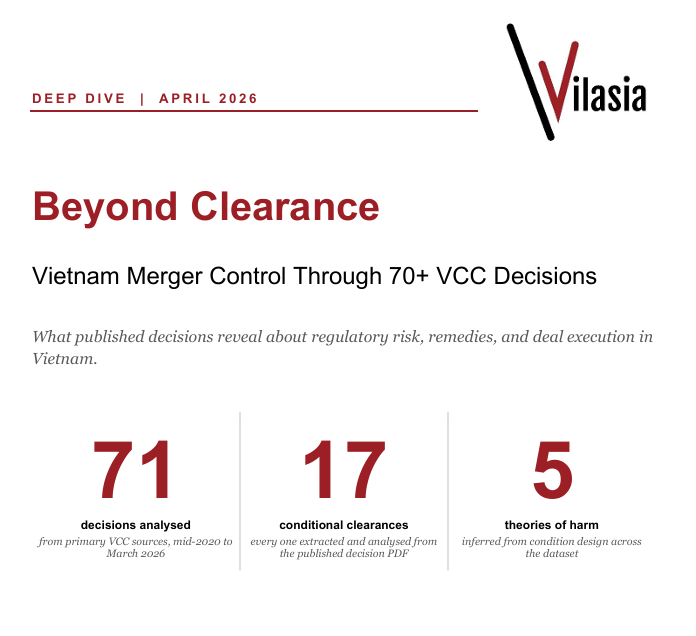
This is the first analysis of Vietnam merger control built from primary VCC decisions, covering all 71 published outcomes from mid-2020 to March 2026.

But the value is not the dataset. It is what the decisions reveal.

Vietnam’s merger control regime has not evolved through legislation. It has evolved through enforcement. The VCC is building a regulatory system deal by deal, using conditional clearances as its primary instrument.

Vietnam does not operate a clearance regime. It operates a conduct regime.

The VCC is imposing perpetual, transaction-specific behavioural regulation with no sunset clause. Conditions are no longer generic compliance undertakings. They are bespoke tools targeting specific competitive risks: pricing formulas, supply access, distribution control, capacity allocation, and, in some cases, the acquirer’s entire value chain.

Three structural shifts define the current regime:

  • From template to design: in under three years, conditions have moved from boilerplate reporting to transaction-specific regulatory frameworks calibrated to the identified harm.
  • From transaction to group: the VCC tracks cumulative position across sequential acquisitions and escalates obligations at the portfolio level, not the deal level.
  • From competition to outcomes: in sensitive sectors, the VCC is beginning to require positive economic commitments, including consumer access, technology transfer, and capability upgrades.

The practical risk in Vietnam is not prohibition. It is indefinite post-closing regulation attached to clearance.

If you are advising on or executing deals in Vietnam, this report shows what the VCC actually does: how it defines markets, how it identifies risk, how it designs remedies, and how those remedies will affect your transaction before and after closing.

Read the full report below — decision by decision, condition by condition. Understand how the VCC will assess your deal.

Vilasia_Deep Dive Beyond Clearance (EN).260420 (Final-Protected)

(VN/EN) Watt Weekly: The Two-Component Electricity Tariff: Key Legal Aspects – Giá Bán Điện Hai Thành Phần: Một Số Khía Cạnh Pháp Lý

Welcome to Vilasia Watt Weekly—your high-voltage gateway to the pulse of Vietnam’s renewables revolution. In each electrifying edition, we illuminate the nation’s shifting energy policies, fresh regulations, and ramped-up enforcement measures that shape the industry’s momentum. Our mission is to energize your perspectives on Vietnam’s low-carbon transition—whether you’re navigating legal compliance, scouting clean power investments, or simply captivated by the winds of change sweeping through the energy landscape. Join us as we shine a spotlight on the empowering developments that are charging Vietnam’s future with sustainable possibility.
Chào mừng quý độc giả đến với Vilasia Watt Weekly—“cánh cổng cao thế” dẫn lối vào nhịp đập sôi động của cuộc cách mạng năng lượng tái tạo tại Việt Nam. Trong mỗi ấn phẩm tràn đầy sức sống, chúng tôi sẽ soi rọi những chuyển biến trong chính sách năng lượng, các quy định mới, cùng các biện pháp tăng cường thực thi đang định hình đà phát triển của toàn ngành. Sứ mệnh của chúng tôi là tiếp thêm “năng lượng” cho góc nhìn của bạn về con đường giảm phát thải carbon—dù bạn đang tìm hiểu về tuân thủ pháp lý, tìm kiếm cơ hội đầu tư năng lượng sạch, hay đơn giản chỉ say mê trước luồng gió đổi thay thổi bùng bức tranh năng lượng Việt. Hãy đồng hành cùng chúng tôi để khám phá những bước tiến vững chắc, góp phần “sạc” đầy tiềm năng bền vững cho tương lai đất nước.

Follow Vilasia Watt Weekly on LinkedIn
Theo dõi các bài mới của Vilasia Watt Weekly trên LinkedIn

In this 28th edition of Vilasia Watt Weekly, we approach Vietnam’s two-component electricity tariff from a legal standpoint — examining what the current framework actually permits, what gaps remain, and what businesses should be doing now. The single-component tariff has a well-documented structural flaw: charging solely on consumption (kWh) treats customers with fundamentally different load profiles as financially equivalent, resulting in unreasonable cross-subsidization. The legal architecture to fix this is already largely in place, spanning the Electricity Law 2024, Decision 14/2025/QD-TTg, Decree 146/2025/ND-CP, and Politburo Resolution 70. Yet the mechanism remains on paper: EVN’s trial has been running since October 2025, MOIT has proposed a one-year extension to gather multi-seasonal data, and the Prime Minister’s activation instrument — the document that would give the new tariff real billing effect — has not yet been issued. For businesses, the clock is running. Whether the new tariff applies automatically or requires a supplemental agreement to existing PPAs remains unresolved. DPPA participants face the additional risk of paying the capacity charge twice under the current structure. This edition maps the legal exposure and sets out what proactive businesses should be reviewing before the activation instrument arrives.

Trong số thứ 28 này, Vilasia Watt Weekly tiếp cận cơ chế giá bán lẻ điện hai thành phần của Việt Nam từ góc độ pháp lý — phân tích khung pháp luật hiện hành đang cho phép đến đâu, những khoảng trống nào còn tồn tại, và doanh nghiệp cần làm gì ngay từ bây giờ. Biểu giá điện một thành phần có một bất cập cấu trúc được ghi nhận rõ ràng: chỉ tính tiền theo sản lượng tiêu thụ (kWh) đã cào bằng trách nhiệm tài chính của các khách hàng có đặc tính phụ tải hoàn toàn khác biệt, dẫn đến hiện tượng trợ giá chéo bất hợp lý. Nền tảng pháp lý để khắc phục điều này về cơ bản đã hình thành, trải dài qua Luật Điện lực 2024, Quyết định 14/2025/QĐ-TTg, Nghị định 146/2025/NĐ-CP và Nghị quyết 70 của Bộ Chính trị. Tuy vậy, cơ chế vẫn đang dừng ở mức thử nghiệm trên giấy: EVN triển khai thử nghiệm từ tháng 10/2025, Bộ Công thương đề xuất kéo dài thêm một năm để phân tích dữ liệu đa mùa, và văn bản kích hoạt của Thủ tướng Chính phủ — văn bản sẽ cho phép áp dụng giá điện mới trên hóa đơn thực tế — đến nay vẫn chưa được ban hành. Với doanh nghiệp, thời gian không còn nhiều. Câu hỏi liệu giá mới tự động áp dụng hay cần có phụ lục sửa đổi đối với PPA hiện hành vẫn chưa có lời giải. Doanh nghiệp tham gia DPPA còn đối mặt thêm nguy cơ trả tiền công suất hai lần do sự giao thoa cấu trúc giữa hai cơ chế. Số này lập bản đồ rủi ro pháp lý và chỉ ra những gì doanh nghiệp cần chủ động rà soát trước khi văn bản kích hoạt được ban hành.

Vilasia Watt Weekly is published every Tuesday at 3pm. Subscribe for updates on Vietnam’s energy landscape.
Vilasia Watt Weekly phát hành mỗi thứ Ba lúc 3 giờ chiều. Đăng ký để cập nhật bức tranh năng lượng Việt Nam.

Download the PDF here
Tải bản PDF ở đây

Vilasia-Watt-Weekly-No.28-Bil-260428

Browse back issues of Vilasia Watt Weekly here
Xem lại các số trước của Vilasia Watt Weekly ở đây

(VN/EN) Watt Weekly: Vietnam’s FiT Dispute: What’s Actually Happening Now – Tranh Chấp Giá FiT tại Việt Nam: Diễn Biến Thực Tế Hiện Nay

Welcome to Vilasia Watt Weekly—your high-voltage gateway to the pulse of Vietnam’s renewables revolution. In each electrifying edition, we illuminate the nation’s shifting energy policies, fresh regulations, and ramped-up enforcement measures that shape the industry’s momentum. Our mission is to energize your perspectives on Vietnam’s low-carbon transition—whether you’re navigating legal compliance, scouting clean power investments, or simply captivated by the winds of change sweeping through the energy landscape. Join us as we shine a spotlight on the empowering developments that are charging Vietnam’s future with sustainable possibility.
Chào mừng quý độc giả đến với Vilasia Watt Weekly—“cánh cổng cao thế” dẫn lối vào nhịp đập sôi động của cuộc cách mạng năng lượng tái tạo tại Việt Nam. Trong mỗi ấn phẩm tràn đầy sức sống, chúng tôi sẽ soi rọi những chuyển biến trong chính sách năng lượng, các quy định mới, cùng các biện pháp tăng cường thực thi đang định hình đà phát triển của toàn ngành. Sứ mệnh của chúng tôi là tiếp thêm “năng lượng” cho góc nhìn của bạn về con đường giảm phát thải carbon—dù bạn đang tìm hiểu về tuân thủ pháp lý, tìm kiếm cơ hội đầu tư năng lượng sạch, hay đơn giản chỉ say mê trước luồng gió đổi thay thổi bùng bức tranh năng lượng Việt. Hãy đồng hành cùng chúng tôi để khám phá những bước tiến vững chắc, góp phần “sạc” đầy tiềm năng bền vững cho tương lai đất nước.

Follow Vilasia Watt Weekly on LinkedIn
Theo dõi các bài mới của Vilasia Watt Weekly trên LinkedIn

In this 27th edition of Vilasia Watt Weekly, we go beyond the headlines on Vietnam’s USD 13 billion feed-in tariff (FiT) dispute – and examine what is actually happening on the ground. For nearly a year, the dispute appeared stuck in a familiar loop: investor petitions, government reviews, no definitive resolution. What has received far less attention is that since January 2026, a centralized resolution framework has quietly taken shape. Five policy instruments were issued in just four months, placing 167 solar and wind projects under a single review and bottleneck-clearing mechanism. Gia Lai has become the first province to complete the entire administrative process for all 15 of its FiT projects. Meanwhile, new Prime Minister Lê Minh Hưng has pledged to remove obstacles for renewable energy projects with a resolution plan targeted for Q2 2026. The key question is no longer whether a pathway exists – but whether it will deliver a genuine commercial resolution, including full restoration of contractual FiT cashflows, before foreign investors from five business chambers make good on their legal threats.

Trong số 27 này, Vilasia Watt Weekly đi sâu hơn các tiêu đề báo chí về tranh chấp giá điện ưu đãi (FiT) trị giá 13 tỷ đô la Mỹ tại Việt Nam – để phân tích những gì đang thực sự diễn ra. Suốt gần một năm, tranh chấp dường như vẫn lặp lại một vòng quen thuộc: nhà đầu tư kiến nghị, Chính phủ rà soát, nhưng chưa có giải pháp dứt điểm. Điều ít được chú ý là từ tháng 1/2026, một khuôn khổ xử lý tập trung đã lặng lẽ hình thành: năm văn bản chính sách lần lượt được ban hành chỉ trong bốn tháng, đưa 167 dự án điện mặt trời và điện gió vào cùng một cơ chế rà soát và tháo gỡ vướng mắc. Gia Lai trở thành tỉnh đầu tiên hoàn tất toàn bộ quy trình xử lý hành chính cho cả 15 dự án FiT trên địa bàn. Trong bối cảnh đó, tân Thủ tướng Lê Minh Hưng cam kết tháo gỡ dứt điểm vướng mắc cho các dự án năng lượng tái tạo và hướng tới xây dựng phương án giải quyết trong quý II/2026. Câu hỏi đặt ra không còn là liệu có lộ trình hay không – mà là liệu lộ trình đó có đủ để dẫn tới giải pháp thương mại thực chất, bao gồm khôi phục đầy đủ dòng tiền hợp đồng theo giá FiT, trước khi các nhà đầu tư nước ngoài từ năm hiệp hội doanh nghiệp biến mối đe dọa pháp lý thành hành động thực tế.

Vilasia Watt Weekly is published every Tuesday at 3pm. Subscribe for updates on Vietnam’s energy landscape.
Vilasia Watt Weekly phát hành mỗi thứ Ba lúc 3 giờ chiều. Đăng ký để cập nhật bức tranh năng lượng Việt Nam.

Download the PDF here
Tải bản PDF ở đây

Vilasia-Watt-Weekly-No.27-Bil-260414

Browse back issues of Vilasia Watt Weekly here
Xem lại các số trước của Vilasia Watt Weekly ở đây

(VN/EN) Watt Weekly: Energy Security on All Fronts – An Ninh Năng Lượng trên Mọi Mặt Trận

Welcome to Vilasia Watt Weekly—your high-voltage gateway to the pulse of Vietnam’s renewables revolution. In each electrifying edition, we illuminate the nation’s shifting energy policies, fresh regulations, and ramped-up enforcement measures that shape the industry’s momentum. Our mission is to energize your perspectives on Vietnam’s low-carbon transition—whether you’re navigating legal compliance, scouting clean power investments, or simply captivated by the winds of change sweeping through the energy landscape. Join us as we shine a spotlight on the empowering developments that are charging Vietnam’s future with sustainable possibility.
Chào mừng quý độc giả đến với Vilasia Watt Weekly—“cánh cổng cao thế” dẫn lối vào nhịp đập sôi động của cuộc cách mạng năng lượng tái tạo tại Việt Nam. Trong mỗi ấn phẩm tràn đầy sức sống, chúng tôi sẽ soi rọi những chuyển biến trong chính sách năng lượng, các quy định mới, cùng các biện pháp tăng cường thực thi đang định hình đà phát triển của toàn ngành. Sứ mệnh của chúng tôi là tiếp thêm “năng lượng” cho góc nhìn của bạn về con đường giảm phát thải carbon—dù bạn đang tìm hiểu về tuân thủ pháp lý, tìm kiếm cơ hội đầu tư năng lượng sạch, hay đơn giản chỉ say mê trước luồng gió đổi thay thổi bùng bức tranh năng lượng Việt. Hãy đồng hành cùng chúng tôi để khám phá những bước tiến vững chắc, góp phần “sạc” đầy tiềm năng bền vững cho tương lai đất nước.

Follow Vilasia Watt Weekly on LinkedIn
Theo dõi các bài mới của Vilasia Watt Weekly trên LinkedIn

Vilasia Watt Weekly is back with Issue No. 26, covering a landmark week in which Vietnam issued a rapid-fire series of decisions converging on a single theme: energy security. In this edition, we spotlight five major developments from the final week of March 2026. Vietnam formally approved its updated JETP Implementation Roadmap (Decision 458), setting ambitious targets of 47% renewables by 2030 and 80–85% primary renewable energy by 2050. Prime Minister Pham Minh Chinh signed Directive 10 to push electricity conservation and rooftop solar, with financial support for household solar and BESS due by April 2026. A National Appraisal Council was established for the Ninh Thuan 1 Nuclear Power Project, marking a concrete step in reviving Vietnam’s nuclear ambitions. The Ministry of Industry and Trade is reviewing Forum recommendations on unlocking financing for large-scale power projects through government guarantees, JETP/AZEC concessional lending, and banking reform. Finally, the PM visited Nghi Son Refinery to fast-track a strategic crude oil reserve – a signal that fuel supply security is now as urgent as the clean energy transition itself.

Vilasia Watt Weekly trở lại với Số 26, điểm lại một tuần bận rộn với hàng loạt quyết sách hội tụ về một chủ đề duy nhất: an ninh năng lượng. Trong số này, chúng tôi phân tích năm diễn biến trọng tâm của tuần cuối tháng 3/2026. Việt Nam phê duyệt Đề án cập nhật triển khai JETP (Quyết định 458), đặt mục tiêu năng lượng tái tạo đạt 47% tổng công suất vào 2030 và 80–85% năng lượng sơ cấp vào 2050. Thủ tướng Phạm Minh Chính ký Chỉ thị 10 thúc đẩy tiết kiệm điện và điện mặt trời mái nhà, với chính sách hỗ trợ tài chính cho hộ gia đình phải hoàn thiện trong tháng 4/2026. Hội đồng thẩm định quốc gia cho Dự án Điện hạt nhân Ninh Thuận 1 được thành lập – bước đi cụ thể trong hành trình tái khởi động điện hạt nhân. Bộ Công Thương đang xem xét các kiến nghị từ Diễn đàn Nghị quyết 70 về tháo gỡ rào cản tài chính cho các dự án nguồn điện lớn thông qua bảo lãnh Chính phủ, vốn ưu đãi JETP/AZEC và cải cách ngân hàng. Cuối cùng, Thủ tướng thị sát Nghi Sơn và chỉ đạo đẩy nhanh xây dựng kho dầu chiến lược – tín hiệu rõ ràng rằng an ninh nhiên liệu đang được đặt ngang hàng với chuyển đổi năng lượng sạch.

Vilasia Watt Weekly is published every Tuesday at 3pm. Subscribe for updates on Vietnam’s energy landscape.
Vilasia Watt Weekly phát hành mỗi thứ Ba lúc 15h. Đăng ký để cập nhật bức tranh năng lượng Việt Nam.

Download the PDF here
Tải bản PDF ở đây

Vilasia-Watt-Weekly-No.26-Bil-260407

Browse back issues of Vilasia Watt Weekly here
Xem lại các số trước của Vilasia Watt Weekly ở đây

(EN) Nissha – USM Healthcare: When M&A Becomes a Supply Chain Strategy

The Vietnamese version is available here.

The recently announced Nissha – USM Healthcare transaction is drawing attention – not only as a healthcare M&A deal, but also as a clear example of how global supply chains are being restructured across Asia.

In this article, Vilasia’s Ngu Truong and Nam Trinh examine the transaction beyond its surface, highlighting how strategic considerations – including “China Plus One”, technology integration, and CDMO expansion – are shaping investment decisions in Vietnam’s medical device sector.

Through a detailed analysis of valuation approaches, regulatory considerations, and post-M&A integration challenges, the article shows how investors are increasingly pricing future growth potential rather than current financial performance, while also navigating a multi-layered legal and compliance framework.

The article also offers practical insights for Vietnamese companies engaging with Japanese investors, from due diligence expectations to transaction structuring and post-deal governance.

The article was originally published in Vietnamese in The Saigon Times on April 2, 2026.

Nissha – USM Healthcare: When M&A Becomes a Supply Chain Strategy

Truong Huu Ngu – Trinh Ngoc Nam (*)

The acquisition by Japan’s Nissha of a 60% stake in USM Healthcare may, at first glance, appear to be a conventional healthcare M&A transaction. Viewed in the broader context of global supply chains, however, it offers a clear illustration of how multinational corporations are repositioning manufacturing footprints across Asia.

USM is widely regarded as Vietnam’s only manufacturer of coronary stents. The value of the transaction therefore lies not merely in the company’s current revenue or asset base, but in its technological capabilities and its position within the regional healthcare value chain.

Against the backdrop of the “China Plus One” strategy, many industrial groups are actively diversifying production away from China. Vietnam has emerged as a compelling alternative, supported by competitive costs, an extensive network of free trade agreements, and growing localisation capabilities. From this perspective, Nissha is not simply acquiring a company; it is securing technology and a strategic position within the regional healthcare supply chain.

Valuation: Buying the Future, Not the Past

A notable feature of the transaction is its valuation approach.

In technology and medical device transactions, buyers typically do not rely primarily on current earnings. Instead, they focus on long-term growth potential—across products, markets, and underlying technologies.

Nissha’s use of the discounted cash flow (DCF) method reflects this approach. For listed companies in Japan, disclosure of valuation methodologies in M&A transactions forms part of broader transparency obligations to shareholders and regulators. As a result, Japanese acquirers often engage independent valuation firms and disclose the basis of their valuation.

The DCF method allows the business to be assessed based on projected future cash flows rather than historical financial performance—an important distinction in the case of USM Healthcare. Publicly available data indicates that the company’s recent profits have been modest. If valuation were based solely on conventional metrics such as P/E multiples or net asset value, the implied valuation would likely be significantly lower.

DCF supports a different investment thesis: USM’s value lies in its growth potential once integrated into Nissha’s global customer network and its ability to scale within a contract development and manufacturing organisation (CDMO) model.

In substance, Nissha is not paying for USM’s current state. It is pricing the future performance that the business can achieve within its broader ecosystem.

An Open Market—But Not Without Barriers

Vietnam’s medical device sector is relatively open to foreign investment and, unlike pharmaceuticals, is not subject to foreign ownership caps. That said, openness does not equate to simplicity.

A transaction such as Nissha–USM must navigate multiple regulatory layers: foreign investment procedures for acquiring a controlling stake, potential economic concentration (antitrust) filings, sector-specific regulatory requirements for medical devices, cross-border capital payment rules, and the accurate handling of tax obligations arising from share transfers.

The legal environment may be more accommodating than in certain other sectors, but successful execution still depends on careful structuring and disciplined process management.

Where Value Is Really Created: Post-Transaction Integration

In many M&A transactions, the principal risks do not lie at signing, but in post-closing integration.

For USM Healthcare, maintaining eligibility for existing incentives requires continued compliance with research and development criteria. In addition, regulatory approvals—particularly market authorisation licences for higher-risk medical devices—must be carefully managed throughout the transition period.

This underscores a broader point: post-acquisition value is not determined solely by the share purchase agreement, but by the effectiveness of integration and ongoing governance.

A Transaction Structurally Simpler Than Precedents

Compared with earlier healthcare transactions in Vietnam—such as Taisho’s investment in Hau Giang Pharma, ASKA’s in Ha Tay Pharma, or Abbott’s acquisition of Glomed—the Nissha–USM transaction appears structurally more straightforward.

USM is not a public company, eliminating the need for complex public tender offer procedures. The medical device sector does not impose foreign ownership restrictions comparable to those in pharmaceuticals. Moreover, the acquisition was executed in a single step sufficient to secure control, rather than through gradual stake accumulation.

Nevertheless, “simpler” does not mean “simple”. Experience from prior transactions shows that outcomes continue to depend heavily on preparation quality, the depth of due diligence, and the parties’ ability to manage risk throughout the process.

Working with Japanese Investors: Practical Considerations

Several practical observations can be drawn from this transaction and comparable precedents involving Japanese investors.

First, the “ringi” decision-making process should be properly understood. Investment decisions typically require multiple layers of internal approval, which may extend timelines beyond initial expectations. However, once approved, Japanese investors tend to demonstrate a high degree of commitment and consistency.

Second, due diligence standards are typically rigorous. Japanese investors place significant emphasis on transparency and documentation, requiring target companies to prepare comprehensive records—particularly in heavily regulated sectors such as medical devices.

Third, transaction documentation must be carefully structured to allocate post-closing risk. Representations and warranties, conditions precedent, indemnities, escrow arrangements, and earn-out mechanisms all play a central role.

Fourth, regulatory diligence in the medical device sector is particularly critical. The status of product registrations (especially for higher-risk classifications), pricing declaration obligations, post-market surveillance requirements, and certifications such as ISO 13485 can all directly affect enterprise value.

Fifth, cross-border healthcare transactions typically require coordinated, multi-disciplinary advisory teams. Legal, tax, financial, and industry expertise must be integrated to address overlapping technical and regulatory issues.

Finally, integration into a multinational group will inevitably increase intra-group transactions. Advance planning for transfer pricing compliance is therefore essential in the post-acquisition phase.

A Broader Shift in Vietnam’s M&A Market

The Nissha–USM transaction reflects a broader trend in Vietnam’s M&A landscape: enterprise value is increasingly driven by technology, data, and research capabilities rather than by current financial performance alone.

As a result, the central question in modern M&A is no longer simply “What is this company worth?” but rather “Where does this transaction position the buyer within the global value chain?”

___________________________________

(*) Vilasia Law Firm

(VN) Thương Vụ Nissha – USM Healthcare: Khi M&A Trở Thành Chiến Lược Chuỗi Cung Ứng

The recently announced Nissha – USM Healthcare transaction is drawing attention – not only as a healthcare M&A deal, but also as a clear example of how global supply chains are being restructured across Asia.

In this article, Vilasia’s Ngu Truong and Nam Trinh examine the transaction beyond its surface, highlighting how strategic considerations – including “China Plus One”, technology integration, and CDMO expansion – are shaping investment decisions in Vietnam’s medical device sector.

Through a detailed analysis of valuation approaches, regulatory considerations, and post-M&A integration challenges, the article shows how investors are increasingly pricing future growth potential rather than current financial performance, while also navigating a multi-layered legal and compliance framework.

The article also offers practical insights for Vietnamese companies engaging with Japanese investors, from due diligence expectations to transaction structuring and post-deal governance.

The article was originally published in Vietnamese in The Saigon Times on April 2, 2026.

Nissha - USM Healthcare Transaction

(EN) “Renewing” a Project’s Legal Lifecycle through Transfer?

Recent regulatory changes under Resolution 254/2025/QH15 are reshaping how investors approach project transfers involving land use rights in Vietnam.

In this article, Vilasia’s Nhung Nguyen examines how the ability to adjust land use terms upon project transfer could effectively “renew” a project’s lifecycle—potentially unlocking stalled developments while also raising important policy questions around scope of application, land use efficiency, and the alignment between land use term and project duration.

Originally published in The Saigon Times on 19 March 2026.

Read the full article in Vietnamese: https://vil.asia/vn-lam-moi-vong-doi-du-an-qua-chuyen-nhuong

“Renewing” a Project’s Legal Lifecycle through Transfer?

One of the notable aspects of National Assembly Resolution 254/2025/QH15, which establishes mechanisms and policies to resolve difficulties in implementing the Land Law (“Resolution 254”), relates to the transfer of investment projects involving land use. Under the new framework, when an investor acquires a project through transfer, the land use term may be readjusted, provided the investor pays supplementary land rental fees as prescribed.

With numerous real estate projects across the country stalled for years due to legal obstacles, this provision is seen as a breakthrough and is expected to give significant impetus to the project M&A market going forward.

A Breakthrough Measure

Under the Land Law 2024 and its predecessors[1], project land is allocated or leased for a maximum of 50 years, with only certain exceptional cases extending to 70 years. Adjustments or extensions are permitted but may not exceed this ceiling.

Under the Real Estate Business Law 2023, a transferee investor must commit to continuing the project as approved[2], including the form, purpose and term of land use. Although the law leaves room for adjustments to project content, in practice the land use term is typically carried over unchanged. The transferee therefore inherits only the remaining period. If, for example, a project was allocated land for 50 years but 20 years have already elapsed, the new investor would have just 30 years left for legal procedures, construction and commercial operations.

This makes project transfers unattractive in many cases, particularly where the project has been “stalled” for a long time. Investors face substantial restructuring costs yet can only recoup their investment over a significantly shortened horizon.

Allowing the land use term to be readjusted upon transfer is therefore a genuinely significant step.

From a legal standpoint, this is the first time the possibility of “renewing” a project’s legal lifecycle has been expressly provided for in the specific context of project transfer. The transferee no longer needs to evaluate feasibility against the remaining term alone but can plan around an extended timeframe.

For real estate M&A, the implications for deal structuring could be substantial. When acquiring a project, an investor may typically consider — alongside a direct project transfer — a transfer of the project’s constructed works or a transfer of equity in the project company. Previously, the land use term was essentially the same under each structure, being whatever time remained. Under the new provision, a project transfer could become distinctly more advantageous than the alternatives.

From a market perspective, the mechanism could deliver meaningful benefits.

Over many years, real estate projects across Vietnam have been stalled by planning changes, financial difficulties on the part of the original developer, or legal obstacles. These “stalled” projects were typically allocated land long ago, leaving limited time on the clock.

If a new investor can have the land use term reset upon transfer, the incentive to step in and restructure these projects increases considerably. This could unlock a substantial volume of land currently stuck in the system, while generating new supply for the real estate market.

Viewed in this light, Resolution 254 offers an important mechanism for resolving the backlog of stalled projects.

That said, the provision also raises a number of policy questions that need to be addressed.

Unanswered Questions

Scope of Application

Article 4.7 of Resolution 254 refers only to the obligation to pay supplementary land rental fees when a project is transferred. It does not mention “land use fees – the charges applicable where land is allocated to an investor rather than leased.

The detailed implementing regulations for Resolution 254[3] similarly go no further than prescribing how the supplementary land rental amount is to be calculated.

This suggests that the readjustment mechanism may apply only to projects on leased land, leaving projects on allocated land – where land use fees apply – outside its scope.

In practice, mixed-use residential and commercial-service projects, not just purely residential ones, are subject to land allocation rather than leasehold. If the authorities adopt this narrower reading, the residential component would be unaffected, but the commercial-service component could remain locked into the original timeframe even after the project has changed hands. This gap would deprive investors of the very relief the policy was designed to provide, at least for those project components sitting on leased land.

Efficient Land Use and the Risk of “Project Flipping”

Resolution 254 establishes a highly permissive mechanism. Beyond requiring the investor to pay supplementary land rental, it imposes no conditions regarding the project’s minimum remaining term, planning status or other qualifying circumstances.

If transferring a project effectively means resetting the land use clock, there is a real risk that investors will hold land banks without developing them, simply waiting for a buyer. Each successive transfer would trigger a fresh readjustment, extending the project’s legal lifecycle indefinitely. Without adequate controls, this could weaken the incentive to develop on schedule and, over time, erode the efficiency of land use.

Land Use Term versus Project Operating Term

Under existing rules, the land use term is determined by reference to the investment project’s operating term[4]. The Investment Law 2025, consistent with its predecessors, caps that operating term at 50 years or 70 years[5]. Investors may apply to adjust the operating term during the life of a project, but not beyond this ceiling.

In practice, for land-based projects – particularly in real estate – both the operating term and the land use term are typically set at the maximum from the outset. Investors therefore rarely need to apply for an adjustment.

The extension of a project’s operating term beyond its original maximum upon transfer is addressed for the first time in the Investment Law 2025, which takes effect on 1 March 2026. This is itself considered a significant development.

However, while Resolution 254 allows the land use term to be readjusted on a virtually unconditional basis, the investment law subjects extensions of the operating term to more demanding requirements. This creates a notable misalignment between the investment and land law regimes in respect of these two types of terms.

To adjust the operating term upon project transfer, the following conditions must all be satisfied[6]:

(i) the project was commenced before 1 March 2025;

(ii) the land use right certificate has been issued and all land-related financial obligations have been fulfilled;

(iii) the project is not subject to termination; and

(iv) the remaining operating term is insufficient to support the transferee’s financial or business plan.

Projects that do not meet these conditions will not qualify for an operating term adjustment upon transfer. This raises a difficult question: can the transferee rely on Resolution 254 to extend the land use term while the operating term remains unchanged? And even if the land use term is successfully readjusted but falls out of step with the operating term, what practical difficulties will the investor face over the long course of developing and operating the project?

Taken as a whole, Resolution 254 opens up a new and significant approach to the project transfer market.

If properly designed and implemented, this mechanism could become an important tool for restructuring stalled projects, unlocking land that has been tied up for years and injecting fresh momentum into the market.

For the mechanism to work effectively, however, several key issues still need to be clarified through guidance and implementation – including the scope of application, controls to ensure efficient land use, and the relationship between the land use term and the project’s operating term.

How these issues are resolved will determine whether the new mechanism becomes a genuinely effective instrument for the market, or remains a provision that proves difficult to apply in practice.

___________________________________

[1] Land Law 2024, Article 172.1(c); Land Law 2003, Article 126.3; Land Law 2003, Article 67.1.

[2] Real Estate Business Law 2023, Article 40.2.

[3] Decree 50/2026/ND-CP, Article 9.

[4] Land Law 2024, Article 172.1(c).

[5] Investment Law 2025, Article 31.2; Investment Law 2020, Article 44.2; Investment Law 2014, Article 43.

[6] Investment Law 2025, Article 52.6.
(VN) “Làm mới” vòng đời dự án qua chuyển nhượng?

Recent regulatory changes under Resolution 254/2025/QH15 are reshaping how investors approach project transfers involving land use rights in Vietnam.

In this article, Vilasia’s Nhung Nguyen examines how the ability to adjust land use terms upon project transfer could effectively “renew” a project’s lifecycle—potentially unlocking stalled developments while also raising important policy questions around scope of application, land use efficiency, and the alignment between land use term and project duration.

Originally published in The Saigon Times on 19 March 2026.

“Renewing” a Project's Lifecycle through Transfer

(EN) The Marico–Skinetiq Transaction: When M&A Must Also “Acquire” Personal Branding

The recently announced Marico – Skinetiq transaction has drawn attention not only for its roughly VND 750 billion value, but also for the legal questions it raises in Vietnam’s evolving M&A landscape.

In this article, Vilasia’s Ngu Truong and Nam Trinh discusses key issues highlighted by the deal, including competition law notification thresholds, the implications of a Vietnamese company becoming foreign-invested after the transaction, and the use of multi-stage payment structures to allocate post-closing risk.

The article also explores a distinctive feature of modern D2C transactions: when enterprise value is closely tied to a founder’s personal brand, acquiring shares may not necessarily mean acquiring the business’s most valuable asset.

The article was originally published in Vietnamese in The Saigon Times on March 5, 2026. The digital version is available here.

The Marico–Skinetiq Transaction: When M&A Must Also “Acquire” Personal Branding

On 9 February 2026, Marico Limited, an Indian fast-moving consumer goods conglomerate, announced that, through its Vietnamese subsidiary, Marico South-East Asia Corporation, it had acquired a 75% equity interest in Skinetiq Joint Stock Company for approximately VND 750 billion, thereby implying an equity valuation of approximately VND 1,000 billion.

The transaction has been widely reported in both domestic and international media as a further step in Marico’s strategy to expand its presence in Vietnam’s beauty sector.

At first glance, this appears to be a conventional share acquisition. However, when considered within the context of the direct-to-consumer (D2C) cosmetics industry—where brands are developed on digital platforms and are closely associated with their founders—the transaction raises a set of structurally important legal issues.

75% – Near-Absolute Control

In a joint stock company, ownership of 75% of the charter capital typically enables the shareholder to pass most key resolutions of the General Meeting of Shareholders, including amendments to the company charter, corporate restructuring, and material transactions, subject to quorum requirements and any enhanced approval thresholds under the charter or shareholders’ agreements.

However, the remaining 25% should not be viewed merely as a residual interest retained by the founders. Rather, it functions as a mechanism to preserve operational incentives in the post-acquisition phase. In high-growth enterprises built on personal branding, founders serve not only as shareholders but also as the public face of the brand and a primary distribution channel. Their continued equity participation helps align interests and mitigate the risk of operational disruption during the transition.

Importantly, while the law secures ownership control, it does not automatically ensure the continuity of the personal brand associated with the business. Accordingly, the most critical elements of such transactions often lie in the contractual arrangements surrounding the transaction, rather than in the share transfer agreement itself.

Staggered Payments as a Risk Allocation Mechanism

According to publicly available information, the transaction is structured as a cash consideration payable in multiple tranches. This structure is common in M&A transactions in Vietnam. Typically, a portion of the purchase price is deferred and made conditional upon the satisfaction of specified criteria, such as the absence of undisclosed tax liabilities, the absence of material disputes, or the achievement of agreed post-closing performance targets.

This mechanism enables the acquirer to mitigate risks arising from information asymmetry. However, in the absence of clear contractual provisions governing performance metrics, timing of recognition, and calculation methodologies, contingent payments may become a primary source of post-closing disputes.

Given that Vietnamese law does not provide specific guidance on earn-out arrangements, enforceability depends almost entirely on the quality of contractual drafting and the parties’ evidentiary position in the event of a dispute.

Conversion into a Foreign-Invested Enterprise

The transfer of a 75% equity interest to a foreign investor results in Skinetiq becoming a foreign-invested enterprise. This change is substantive rather than merely formal.

From a regulatory perspective, the transaction must comply with share acquisition registration requirements under the Law on Investment. Subsequently, the company must review its compliance with all applicable business conditions relating to cosmetics distribution and retail activities. Under Decree 09/2018/ND-CP, foreign-invested enterprises engaging in distribution and retail may be required to obtain a business license and satisfy additional conditions, particularly in relation to the establishment of retail outlets.

Where Skinetiq’s operations are primarily conducted through e-commerce and social media platforms, the immediate regulatory impact may be limited. However, if the post-acquisition strategy involves expansion into physical retail networks, these regulatory requirements will need to be addressed proactively.

Notification Thresholds: Beyond the Headline Transaction Value

The disclosed transaction value of approximately VND 750 billion falls below the commonly referenced threshold of VND 1,000 billion for economic concentration notification. However, notification obligations are not determined solely by reference to the headline purchase price.

Under applicable regulations, notification may be triggered if certain thresholds relating to total assets or total revenue in Vietnam of any party to the transaction are met. Accordingly, in transactions involving a domestic target and a multinational acquirer, the relevant analysis must consider not only the size of the target but also the existing scale of the acquirer’s operations in Vietnam.

Furthermore, in transactions structured with multiple tranches or contingent consideration, a practical issue arises as to whether the “transaction value” should be assessed based on the initial payment or the maximum potential consideration. This determination may have a direct impact on notification requirements.

In practice, for transactions approaching regulatory thresholds, the appropriate approach is not to structure or interpret the transaction artificially to avoid thresholds, but to conduct a comprehensive assessment of the parties’ market presence and anticipate potential filing obligations. The principal risk lies not in making a notification, but in completing the transaction and subsequently identifying a failure to notify.

Tax Implications of the Joint Stock Company Structure

An often-overlooked yet significant aspect of the transaction is the legal form of the target company. In the case of joint stock companies, transfers of shares by resident individuals are generally subject to a fixed tax calculated on the transfer value, irrespective of actual gains, rather than on capital gains as is the case for other corporate forms.

This distinction may result in substantial differences in tax liability in high-value transactions. It illustrates that the choice of corporate form at the time of incorporation may have significant implications for exit costs in the future.

The Most Challenging Asset to “Transfer”: Image Rights

The most distinctive feature of this transaction lies in its reliance on the founder’s image rights and reputation. While trademarks may be registered and transferred in accordance with intellectual property law, image rights are intrinsically linked to personal rights and cannot be fully transferred in the same manner as tangible assets.

Accordingly, the acquirer must establish a comprehensive contractual framework governing the use of image rights, promotional obligations, non-compete undertakings, and mechanisms for addressing reputational risks. This is not solely a legal issue, but also one of brand governance and media risk management.

Absent robust contractual arrangements securing rights to the founder’s image and digital distribution channels, ownership of 75% of the equity may not translate into effective control over the business’s core revenue-generating assets.

An Evolving M&A Landscape in Vietnam

Compared with traditional brand acquisitions more than a decade ago, contemporary transaction structures have become significantly more sophisticated. Rather than full upfront acquisitions, acquirers increasingly adopt phased consideration structures, linking deferred payments to business performance and founder retention.

The Marico–Skinetiq transaction therefore reflects not only a strategic expansion, but also the broader evolution of M&A practice in Vietnam. In the digital economy, enterprise value is increasingly derived not from physical assets or inventory but from customer data, distribution capabilities, and personal influence.

In such models, the principal challenge lies not in the transfer of shares, but in ensuring the continuity of value following a change in ownership. Current legal frameworks address this only partially; the remainder depends on the effectiveness of contractual structuring and risk management from the outset.

Contact Us
Email Us

For detailed inquiries, please email us at info@vil.asia.

Call Us

For quick questions or to arrange a meeting, feel free to call us at: (+84) 286 270 8696.

Meet Us in Person

Please visit us at:

Ho Chi Minh City

Aqua 1, Vinhomes Golden River, 2 Ton Duc Thang, Sai Gon Ward

Hanoi

11th Floor, Heritage West Lake Building, 677 Lac Long Quan, Tay Ho Ward