(VN) Thương vụ Marico – Skinetiq: Khi M&A phải “mua” cả thương hiệu cá nhân

The recently announced Marico – Skinetiq transaction has drawn attention not only for its roughly VND 750 billion value, but also for the legal questions it raises in Vietnam’s evolving M&A landscape.

In this article, Vilasia’s Ngu Truong and Nam Trinh discusses key issues highlighted by the deal, including competition law notification thresholds, the implications of a Vietnamese company becoming foreign-invested after the transaction, and the use of multi-stage payment structures to allocate post-closing risk.

The article also explores a distinctive feature of modern D2C transactions: when enterprise value is closely tied to a founder’s personal brand, acquiring shares may not necessarily mean acquiring the business’s most valuable asset.

The article was originally published in Vietnamese in The Saigon Times on March 5, 2026. The digital version is available here.

Marico – Skinetiq transaction

(EN) BJC’s Acquisition of MM Mega Market Vietnam: A Stress Test for Vietnam’s New Capital Transfer Tax Regime

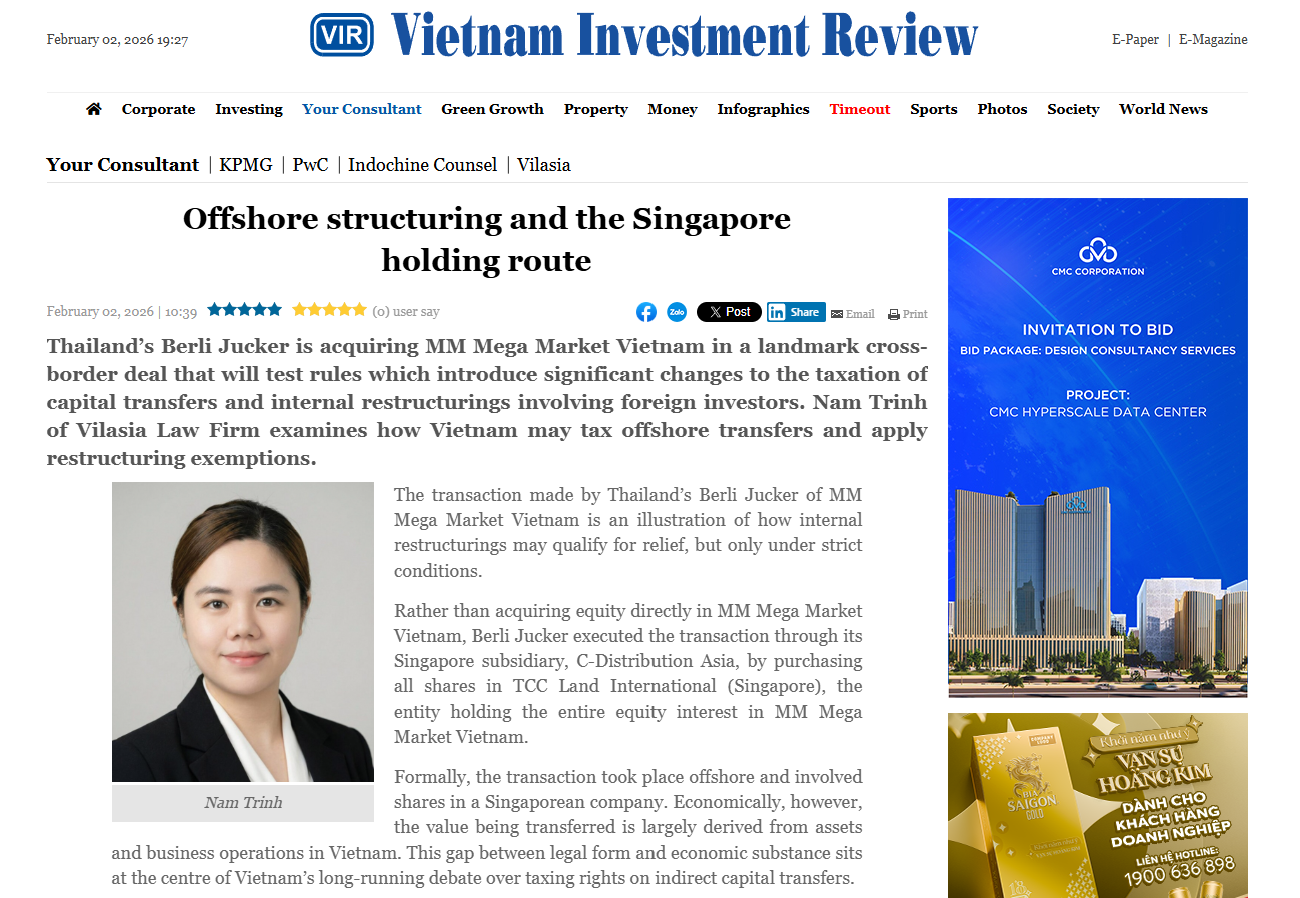
Thailand’s Berli Jucker is acquiring MM Mega Market Vietnam in a landmark cross-border deal that will test rules which introduce significant changes to the taxation of capital transfers and internal restructurings involving foreign investors. Nam Trinh of Vilasia Law Firm examines how Vietnam may tax offshore transfers and apply restructuring exemptions.

The article titled “Offshore Structuring and the Singapore Holding Route”, published by Vietnam Investment Review (VIR) on February 2,2026 and written by Vilasia’s Nam Trinh, further analyses this transaction from a tax and structuring perspective. The article focuses on offshore holding structures—particularly the use of Singapore holding companies—and examines how Vietnam’s evolving tax rules on capital transfers and internal restructurings affect foreign investors in cross-border M&A deals.

Read the full article on VIR: https://vir.com.vn/offshore-structuring-and-the-singapore-holding-route-146015.html 

The transaction made by Thailand’s Berli Jucker of MM Mega Market Vietnam is an illustration of how internal restructurings may qualify for relief, but only under strict conditions.

Rather than acquiring equity directly in MM Mega Market Vietnam, Berli Jucker executed the transaction through its Singapore subsidiary, C-Distribution Asia, by purchasing all shares in TCC Land International (Singapore), the entity holding the entire equity interest in MM Mega Market Vietnam.

Formally, the transaction took place offshore and involved shares in a Singaporean company. Economically, however, the value being transferred is largely derived from assets and business operations in Vietnam. This gap between legal form and economic substance sits at the centre of Vietnam’s long-running debate over taxing rights on indirect capital transfers.

The ownership structure adds another layer of complexity. Both the buyer and seller ultimately fall under the control of TCC Group. This may support the view that the deal is an internal group restructuring rather than a third-party acquisition – a distinction that matters under Decree No.320/2025/ND-CP when considering tax relief.

New tax approach

Historically, capital transfers by foreign organisations in Vietnam were taxed based on net gains, typically at 20 per cent of taxable income calculated as the transfer price minus acquisition cost and allowable expenses. While economically coherent, the approach frequently led to disputes over cost bases, deductible expenses, and how much value should be allocated to Vietnam when the transfer occurred offshore.

Decree 320, implementing amendments to the Law on Corporate Income Tax, signals a shift in regulatory thinking. In certain cases, foreign entities’ income from capital transfers may be taxed using a deemed rate of 2 per cent applied to “taxable revenue arising in Vietnam”. The objective is to simplify administration and improve collectability, especially where tax authorities face practical difficulties verifying costs at offshore holding levels.

Crucially, this is not a blanket 2 per cent levy on the entire global transaction value. For indirect transfers, the key question becomes how much of the consideration should be treated as taxable revenue attributable to Vietnam. That assessment will depend on legal interpretation, valuation methodology, and the strength of supporting evidence.

Although Decree 320 sets out legal conditions on paper, its application to indirect transfers still raises practical uncertainties in complex holding structures.

Firstly, it does not prescribe a single method for determining “taxable revenue arising in Vietnam” where the transferred entity is a holding company with assets or operations in multiple jurisdictions. If the Singapore entity is effectively a single-asset vehicle holding only MM Mega Market Vietnam, authorities may view most or all of the transfer value as Vietnam-derived. Where additional offshore assets or income streams exist, taxpayers may argue for a proportionate allocation, supported by valuation reports and financial data.

Secondly, the boundary between market value and internal restructuring logic remains unclear when determining whether a transaction generates taxable income. Internal transfers may be priced at book value or acquisition cost for restructuring purposes rather than to realise gains.

However, where the transfer price diverges materially from economic value, authorities may challenge whether pricing is market-consistent and exercise their power to reassess. This goes directly to the “no income arises” condition under the internal restructuring exemption.

Thirdly, Decree 320 does not set out a definitive evidentiary threshold for qualifying an internal restructuring for exemption. Open questions include the level of detail required in ownership charts, documentation needed to demonstrate the ultimate parent remains unchanged, financial evidence required to show no income is generated, and proof of compliance with non-cash settlement requirements. In the absence of settled administrative practice, outcomes may depend heavily on case-by-case review.

A frequently cited reference point is the tax amount produced by applying the 2 per cent deemed rate to the full transaction value. On a headline deal value of $772 million, the tax would be approximately $15.4 million. However, that figure relies on the assumption that the entire consideration constitutes taxable revenue arising in Vietnam. Where offshore assets or activities exist, the determination becomes more nuanced and dependent on valuation methodology and documentation.

Impact on future deals

Decree 320 introduces an exemption for internal group restructurings, potentially taking a transaction outside the deemed tax regime if two cumulative conditions are met. Firstly, the transfer must not result in a change to the ultimate parent company of entities that directly or indirectly own the Vietnamese business after the restructuring. Secondly, the transaction must not generate taxable income.

In practice, meeting these conditions typically requires robust valuation work and a coherent commercial rationale. Where book value or acquisition cost is used, the business purpose must be articulated clearly to address potential questions of market consistency. Without this preparation, the risk of reassessment increases.

Because the transferring entity is Singapore-based, the Vietnam–Singapore double taxation agreement will naturally be considered. However, treaty protection is not automatic. Vietnam may retain taxing rights in certain circumstances, notably where the value of transferred shares is derived principally from immovable property located in Vietnam.

Whether this threshold is met depends on the asset composition of the underlying business. Modern retail operations can derive substantial value from leasehold rights, goodwill, and distribution networks, which may not be classified as immovable property for treaty purposes.

Treaty benefits may also be denied if the intermediary lacks economic substance or does not qualify as the beneficial owner under treaty rules. Documentation demonstrating substance in Singapore – such as personnel, premises, and genuine decision-making functions – becomes important where double taxation relief is contemplated.

Vietnam’s approach to indirect transfers is not new. The 2016 Big C transaction remains a prominent example of tax authorities applying substance-over-form reasoning where economic value was clearly rooted in Vietnam. Offshore structuring did not prevent Vietnam from asserting taxing rights when the underlying assets and business operations were domestic.

What distinguishes the Berli Jucker–MM Mega Market Vietnam transaction is the potential availability of an internal restructuring exemption under Decree 320. That opportunity exists, but only where conditions are satisfied and properly substantiated. Otherwise, the deemed tax regime may apply, with disputes likely focusing on the scope of taxable revenue and valuation assumptions.

For cross-border deals involving Vietnam, tax compliance can no longer be treated as a post-closing exercise. Tax obligations arise upon completion of the transfer, making early planning critical. At a minimum, parties should prepare ownership and control records showing the ultimate parent remains unchanged; valuation analyses and a clear commercial rationale supporting the pricing and restructuring logic; payment documentation demonstrating compliant non-cash settlement; and, where relevant, substance evidence to support treaty claims. Investors and deal advisers should also build tax risk allocation into transaction documents, including representations, warranties, and indemnities aligned with the evolving enforcement environment.

Decree 320 marks a significant evolution in Vietnam’s approach to taxing capital transfers involving foreign entities. While the deemed 2 per cent rate may improve administrative efficiency, it shifts the centre of debate to how taxable revenue arising in Vietnam is identified, allocated, and evidenced in indirect transfers.

For investors, the message is clear: careful structuring, early tax analysis, and robust documentation are no longer optional. They are integral to deal success in Vietnam’s new tax environment.

(VN) Thương vụ BJC – MM Mega market Việt Nam: ‘Phép thử’ cho thuế chuyển nhượng vốn theo nghị định 320

The recently announced BJC – MM Mega Market Vietnam transaction has drawn significant attention – not only for its scale, but also for the tax questions it raises under Vietnam’s new capital gain tax regime.

In this article, Vilasia’s Nam Trinh examines the transaction as a potential stress test for the application of Decree 320, particularly in the context of indirect transfers, the determination of Vietnam-sourced taxable revenue, and the availability of tax exemptions for internal group restructurings.

Through a close reading of the transaction structure and the new regulatory framework, the article highlights unresolved issues that are likely to shape tax risk allocation, transaction design, and dispute exposure in future cross-border M&A deals involving Vietnam.

The article was originally published in Vietnamese in The Saigon Times on January 29, 2026. The digital version is available here.

The BJC - MM Mega Market Vietnam Transaction - A Litmus Test for Capital Transfer Tax under Decree 320

(EN) Apartment Building Management: Maintenance Funds Remain a “Hot Spot”

The Vietnamese version is available here.

One year after the Land Law 2024, the Real Estate Business Law 2023, and the Housing Law 2023 came into effect, Vietnam’s real estate legal framework has begun to show both its reform momentum and the challenges of implementation.

Vilasia, in collaboration with The Saigon Times, is pleased to present a series of analytical articles by Vilasia’s Nhung Nguyen, offering a one-year review of how these landmark laws are being implemented in practice. Through real cases and regulatory analysis, the series highlights key issues emerging in areas such as land financial obligations, project transfers, delayed projects, commercial housing development, and project implementation models. The series will aim to provide practitioners, investors, and policymakers with a clearer picture of where the new legal framework is working as intended and where further clarification and adjustment may be needed.

The series focus on five main topics:

(i) Land-Related Financial Obligations: The Strain of Balancing Interests;
(ii) Transfers of Real Estate Projects: Practical Bottlenecks in Implementation;
(iii) Delayed (“Suspended”) Projects: Responsibility Cannot Be Placed Solely on Investors;
(iv) Development and Management of Commercial Housing: Bright Spots and Persistent Bottlenecks; and
(v) Apartment Building Governance: Maintenance Funds Remain a “Hot Spot”.

Below is the last in the series entitled “Apartment Building Governance: Maintenance Funds Remain a “Hot Spot””, originally published in Vietnamese in The Saigon Times on September 6, 2025. The digital version is available here.

Apartment Building Management: Maintenance Funds Remain a “Hot Spot”

By Lawyer Nguyễn Thị Nhung (*)

(The Saigon Times) – After a year in force, the new Land Law 2024, Real Estate Business Law 2023, and Housing Law 2023 have gradually come into practice. Yet, reality still reveals many emerging obstacles stemming both from inconsistencies in the laws themselves and from divergent interpretations and applications among competent authorities. The Saigon Times presents a series of articles analyzing key issues in the implementation of these legal documents.

Housing Law 2023 – Progress in Maintenance Fund Management

During the implementation of the Housing Law 2014, apartment building management revealed many shortcomings, particularly regarding the management and use of maintenance funds. In reality, many investors delayed the handover or lacked transparency in using this fund, leading to prolonged disputes between residents and the Management Board, and even negative incidents such as abuse or misappropriation of maintenance funds.

The Housing Law 2023 introduces important amendments to address these issues, especially regulations related to revenue sources and methods of maintenance fund management, contributing to ensuring the stable operation of apartment buildings.

First, the new law supplements revenue sources for the maintenance fund. Previously, the sole source of maintenance funding was the contribution from residents (initially 2% of the Apartment building value or the area sold/leased-purchased, including the area retained or unsold by the investor), which was temporarily managed by the investor before being handed over to the Management Board. The Housing Law 2023 adds a new, stable, and regular revenue source for this fund: revenue from common ownership areas, typically collected from residents or other organizations and individuals using the common areas of the apartment building (common area revenue).  This revenue source is quite diverse, potentially including elevator advertising, lobby displays, resident parking fees, or standee placement fees.

Regarding the mechanism for managing and handing over maintenance funds, the new law also stipulates strict regulations to protect residents’ rights. Previously, this amount was paid by homebuyers to the investor along with the house purchase price, from which the investor would deduct and deposit it into the maintenance fund account. Now, the Housing Law 2023 requires that the maintenance fund account be opened before the signing of the sale contract or lease-purchase contract, and buyers will pay directly into this account (which bears the investor’s name but is clearly stated in the contract and must be notified to the provincial housing management authority). This new method ensures cash flows directly into the fund account, avoids investor manipulation, ensures transparency, facilitates inspection, and allows for easier enforcement if necessary.

Furthermore, the new law also decentralizes the authority to enforce the handover of maintenance funds from the provincial People’s Committee down to the district level, aiming to create more favorable conditions for implementation. Enforcement cases are clearly defined: enforcement from the general account, maintenance fund account, or business account of the investor, or enforcement through asset seizure and auction. The detailed processes and procedures for each enforcement case create an important legal basis for local authorities and the Management Board to protect the legitimate rights of residents.

Although the mechanism for managing and handing over maintenance funds is prescribed in detail and specifically, the legal status of the body managing this fund, the Management Board, is not clearly regulated by the Housing Law 2023. The Housing Law 2023 no longer defines this board as a legal entity as stipulated in the Housing Law 2014, yet it also does not affirm that this board lacks legal entity status[1]. This lack of clarity contributes to ironic situations during the Management Board’s management and use of maintenance funds, as illustrated in the story below.

Common Area Revenue – Invoicing and Tax Dilemmas

Unlike the traditional contribution of 2% of the Apartment building value (the construction area portion that residents and the investor self-pay into the maintenance fund account to maintain their own daily operations), revenue from common areas is collected from service exploitation activities in the common areas of the Apartment building, which can be considered business activities. Consequently, many apartment buildings have faced significant challenges with invoices and tax obligations.

Specifically, in early May 2025, the Management Board of Conic Dong Nam A apartment building was fined over VND 119 billion by the (former) Binh Chanh District Tax Department for failing to issue invoices when collecting money from residents. Regarding the tax field, tax authorities determined  that the Management Board had evaded over VND 453 million in taxes from leasing telecommunication stations and other operational services, and subsequently transferred the case file to the investigation authority due to signs of criminal violation[2]. To date, the case continues to shock public opinion not only because of the unimaginably large fine amount but also because not only at Conic but at most apartment buildings, Management Boards in practice do not issue invoices nor declare and pay taxes.

Where, then, will the Management Board find the funds to pay the fine?

First, It is necessary to distinguish between the Management Board and the Management Company of the apartment building. While the Management Company is an independent enterprise providing professional Apartment building management and operation services, the Management Board is a representative of the residents, is not an enterprise, and does not operate for profit. After the Management Board is established, it will sign a contract with the Management Company to carry out the management and operation of the apartment building. Only in cases where the apartment building does not have an elevator can the Management Board collect and spend management service fees without needing to hire a Management Company.

The Management Board has a stamp and bank account for operation. However, the Management Board is not independent when participating in legal relations, and most importantly, the Management Board has no assets of its own. Specifically, it is a collection of representatives of residents and the investor. All activities of the Management Board must be reported to residents at the apartment building Meeting or must be carried out according to the operational regulations and financial revenue/expenditure regulations approved by the apartment building Meeting. The Management Board is named as the holder of the maintenance fund and certain other amounts, such as the Management Board’s operating fund or management service fees for small-scale apartment buildings (without elevators). However, any expenditure from these accounts must be reported at the apartment building Meeting for residents to decide[3].

In contrast to the extremely limited capacity of the Management Board under housing and civil laws, tax management laws have an overly broad scope of application by stipulating that an organization that is not an enterprise and does not need to have legal entity status must still issue invoices when collecting money and must pay corporate income tax when having income if it supplies services[4].

When the Management Board violates legal regulations, the assignment of responsibility can be assessed as follows:

Regarding the personal responsibility of the Management Board’s members, Article 148.3 of the Housing Law 2023  and Article 19.5 of the Regulation on Management and Use of apartment buildings (issued with Circular 05/2024/TT-BXD), stipulate that responsibility lies with Board members if the Board or members make decisions exceeding their authority and statutory responsibilities. In this case, if the Board’s collection and expenditure are based on residents’ decisions at the apartment building Meeting and are consistent with operational and financial regulations, Board members cannot be held personally liable. Furthermore, the fact that Management Boards do not issue invoices nor declare and pay VAT and corporate income tax is a fairly common reality in apartment buildings, making it very difficult to assign personal responsibility to any specific member of the Board.

Regarding collective liability, the Board cannot unilaterally decide to use money in the accounts under its name to pay fines because the expenditure of any amount from these accounts must be reported to and decided by the apartment building Meeting.

In terms of the nature of the representation relationship, since the Management Board is the representative body of the residents and operates for the residents’ benefit, it can be said that fining the Board is effectively fining the residents. In reality, residents already have a substantial asset, specifically the maintenance fund. However, residents cannot use this money to pay fines due to regulations restricting the maintenance fund’s usage purposes, including revenue from common areas (an amount that can be considered as derived from business activities)[5]. The amount available in the Board’s operating fund and collected management service fees is not significant, yet its usage must still be reported at the apartment building Meeting.

Therefore, to pay this large fine, it would require resident consensus to use current funds (excluding the maintenance fund) or to make additional contributions if current funds are insufficient. However, achieving a majority consensus from a large number of residents (such as the 242 households in the Conic Dong Nam A case) to voluntarily contribute a fine amounting to hundreds of billions of dong is nearly impossible.

Thus, although there is a penalty decision and a specific deadline, the probability of the Management Board paying this huge fine is virtually zero, making the purpose of administrative sanction difficult to achieve.

Conclusion

Although the Housing Law 2023 has focused on detailing and concretizing regulations related to apartment building governance and maintenance fund management, due to the specific and complex nature of the Apartment building model, many obstacles still arise in practical application.

From the case at Conic Dong Nam A apartment building, it is evident that the Management Board, state management authorities, and the current legal system all need appropriate adjustments. Regarding the Management Board, although it is merely a representative body and lacks specialized departments for finance and accounting, in reality, it manages large sums of money and conducts many collection and expenditure activities on behalf of residents. Therefore, the Management Board needs to gradually improve its operational capacity towards professionalism, ensuring compliance with legal regulations and internal regulations.

Housing and tax laws also need to add specific regulations guiding invoicing, as well as the declaration and payment of Value Added Tax and Corporate Income Tax for maintenance funds in general and common area revenue in particular. At the same time, tax authorities need to proactively disseminate and provide full and timely guidance to Management Boards, Management Companies, and residents regarding relevant obligations before conducting administrative sanctions. This will not only help improve law compliance efficiency but also ensure feasibility, transparency, and reasonableness in applying penalty sanctions.

_________________________________________________

(*) Vilasia Law Firm

[1] Article 103.3, the Housing Law 2014; Article 146.3, the Housing Law 2023.

[2] “Management Board of Conic Dong Nam A apartment building in HCMC fined over VND 119 billion,” dantri.com.vn, https://dantri.com.vn/bat-dong-san/ban-quan-tri-chung-cu-conic-dong-nam-a-o-tphcm-bi-phat-hon-119-ty-dong-20250514110144410.htm (last accessed August 3, 2025).

[3] Article 148.1, the Housing Law 2023 and Article 19.7, Regulation on Management and Use of Apartment buildings.

[4] Article 4, the Law on Value Added Tax 2024; Article 3(e) Decree 181/2025/ND-CP; Article 2.1(dd), the Law on Corporate Income Tax 2008.

[5] Articles 153.4 and Article 155.1, the Housing Law 2023.

(VN) Quản trị nhà chung cư: Quỹ bảo trì vẫn là ‘điểm nóng’

One year after the Land Law 2024, the Real Estate Business Law 2023, and the Housing Law 2023 came into effect, Vietnam’s real estate legal framework has begun to show both its reform momentum and the challenges of implementation.

Vilasia, in collaboration with The Saigon Times, is pleased to present a series of analytical articles by Vilasia’s Nhung Nguyen, offering a one-year review of how these landmark laws are being implemented in practice. Through real cases and regulatory analysis, the series highlights key issues emerging in areas such as land financial obligations, project transfers, delayed projects, commercial housing development, and project implementation models. The series will aim to provide practitioners, investors, and policymakers with a clearer picture of where the new legal framework is working as intended and where further clarification and adjustment may be needed.

The series focus on five main topics:

(i) Land-Related Financial Obligations: The Strain of Balancing Interests;
(ii) Transfers of Real Estate Projects: Practical Bottlenecks in Implementation;
(iii) Delayed (“Suspended”) Projects: Responsibility Cannot Be Placed Solely on Investors;
(iv) Development and Management of Commercial Housing: Bright Spots and Persistent Bottlenecks; and
(v) Apartment Building Governance: Maintenance Funds Remain a “Hot Spot”.

Below is the last in the series entitled “Apartment Building Governance: Maintenance Funds Remain a “Hot Spot””, originally published in Vietnamese in The Saigon Times on September 6, 2025. The digital version is available here.

Bài 5 - Quỹ bảo trì NCC

(EN) Development and Management of Commercial Housing Bright Spots and Persistent Bottlenecks

The Vietnamese version is available here.

One year after the Land Law 2024, the Real Estate Business Law 2023, and the Housing Law 2023 came into effect, Vietnam’s real estate legal framework has begun to show both its reform momentum and the challenges of implementation.

Vilasia, in collaboration with The Saigon Times, is pleased to present a series of analytical articles by Vilasia’s Nhung Nguyen, offering a one-year review of how these landmark laws are being implemented in practice. Through real cases and regulatory analysis, the series highlights key issues emerging in areas such as land financial obligations, project transfers, delayed projects, commercial housing development, and project implementation models. The series will aim to provide practitioners, investors, and policymakers with a clearer picture of where the new legal framework is working as intended and where further clarification and adjustment may be needed.

The series focus on five main topics:

(i) Land-Related Financial Obligations: The Strain of Balancing Interests;
(ii) Transfers of Real Estate Projects: Practical Bottlenecks in Implementation;
(iii) Delayed (“Suspended”) Projects: Responsibility Cannot Be Placed Solely on Investors;
(iv) Development and Management of Commercial Housing: Bright Spots and Persistent Bottlenecks; and
(v) Apartment Building Governance: Maintenance Funds Remain a “Hot Spot”.

Below is the forth in the series entitled “Development and Management of Commercial Housing: Bright Spots and Persistent Bottlenecks”, originally published in Vietnamese in The Saigon Times on August 30, 2025. The digital version is available here.

Development and Management of Commercial Housing Bright Spots and Persistent Bottlenecks

By Lawyer Nguyễn Thị Nhung (*)

(The Saigon Times) – LTS: After one year in  effect, the new laws, including the Land Law 2024, the Real Estate Business Law 2023, and the Housing Law 2023 have gradually come into practice.

However, reality still reveals many emerging obstacles, stemming from both inconsistent regulations and divergent interpretations and applications among regulatory authorities. The Saigon Times presents a series of articles analyzing key issues in the implementation of these legal documents.

Land Fund Policy: Opening the Way for Commercial Housing

On November 30, 2024, the National Assembly passed Resolution 171/2024/QH15 regarding the pilot implementation of commercial housing projects through agreements on receiving land use rights or for land where usage rights are currently held (Resolution 171).

This policy applies nationwide and is not limited to major urban centers, enabling all localities to proactively implement it according to demand. All projects eligible to receive land use rights may participate in the pilot, regardless of whether the land use rights were acquired (or are currently held) before or after Resolution 171 took effect. Furthermore, most land categories specified in Article 9 of the Land Law 2024 are eligible for the transfer of land use rights or the change of land-use purpose to implement commercial housing projects[1].

Immediately after Resolution 171 was issued, the Government promulgated Decree 175/2025/ND-CP on April 1, 2025, detailing the implementation of this pilot mechanism (Decree 175).

The issuance of Resolution 171 and Decree 175 is considered a policy breakthrough, particularly in the context of increasingly scarce land funds in major cities. In reality, the implementation process has proceeded even faster than the speed of policy formulation. Just 37 days after Decree 175 was issued, on May 7, 2025, the Hanoi People’s Committee announced the list of pilot land plots and issued the Approval Notice, marking the completion of procedures for phase 1 with 148 land plots[2]. By July, the list of 150 land plots eligible to participate in phase 2 was also issued[3].

However, a notable point is that neither Resolution 171 nor Decree 175 clearly specifies how to determine the residential land area in each pilot project, which serves as the basis for calculating the total area of all pilot projects to ensure it does not exceed the 30% cap on additional residential land within the approved planning period[4].

This lack of clarity caused confusion in implementation, specifically requiring the Hanoi People’s Committee to send an official dispatch to the (former) Ministry of Natural Resources and Environment requesting guidance. In its written response, the Department of Land Management under the (former) Ministry of Natural Resources and Environment guided that the locality could choose to: (i) refer to relevant regulations on housing project implementation if there are stipulations on the required residential land ratio; or (ii) base the calculation on the actual situation of approved local housing projects (those with 1/500 detailed construction planning or allocated land) to determine the average residential land ratio and apply it uniformly[5]. The absence of a unified determination criterion in both legal documents and guidance from central management agencies may lead to a situation where each locality applies different interpretations and calculation methods. This causes inconsistency in implementation and becomes a barrier to the effective deployment of the pilot policy.

These shortcomings will no longer be a concern when the draft Law amending the Land Law 2024 is passed. Specifically, according to the draft Law amending the Land Law 2024 updated in mid-August 2025[6], the Ministry of Agriculture and Environment has proposed removing the regulation restricting the types of land eligible for agreement to implement commercial housing projects (currently limited to residential land) at Point b, Clause 1, Article 127. In other words, the open policy in Resolution 171 will be codified, with no limits on implementation duration or the total land area subject to agreement. However, the draft Law amending the Land Law 2024 currently does not propose removing this restriction for cases where investors already hold land use rights.

Foreigners and the issue of owning landed houses

Under the Housing Law 2023, foreign individuals and organizations are allowed to purchase housing in commercial projects, including both apartments and landed houses such as townhouses and villas[7]. Compared to domestic organizations and individuals, their ownership is capped in terms of quantity (no more than 30% of units in an apartment building or 250 landed houses in a ward-level administrative area) and duration (up to 50 years)[8], mainly to ensure national defense and security.

However, reality reveals a paradox: foreigners have only been able to exercise ownership rights over apartments, while the issuance of Certificates of Land Use Rights and Ownership of House for landed houses has been blocked nationwide. As a consequence, there are projects where competent authorities have already approved the list of housing eligible for sale to foreigners (including landed houses) and where developers and foreign buyers have signed valid contracts and paid up to 95% of the property value. Yet, the final step of issuing the “Red Book” to the buyer cannot be completed.

The situation described above is causing serious consequences for both parties to the transaction. For foreign buyers, the failure to receive legal ownership certificates prevents them from exercising basic rights such as transfer or mortgage. For developers, as they cannot complete the procedures to issue the Red Book to buyers, they are unable to collect the final payment, which affects project cash flow. Simultaneously, this situation entails legal risks and easily leads to disputes and complaints between parties, damaging corporate reputation and reducing market stability.

In this context, refining the policy is an urgent requirement. If the State determines to allow the sale of landed houses to foreigners, it must urgently review and rectify administrative procedures,  particularly by providing specific guidance to localities on the process of issuing ownership certificates. Conversely, if the policy standpoint is to disallow foreign ownership of landed houses to ensure national defense and security, the Housing Law 2023 should be amended to exclude this housing type from permissible transactions from the outset. At the same time, reviewing and revoking or adjusting the lists of housing previously approved for sale to foreigners is essential to ensure consistency between legal regulations and enforcement practice.

The Airbnb Model: To Allow or To Ban?

The use of apartment units for improper purposes has long been strictly prohibited by law. According to the Land Law 2024, apartment buildings constructed for residential purposes must not be used for other purposes such as tourist lodging, offices, or business services. This is not a new regulation but has been consistently inherited from the Housing Law 2014 to the Housing Law 2023 (amended). However, reality shows that the supervision and handling of violations regarding apartment functionality remain very lax, leading to a situation where many apartments are still rented out short-term in the form of tourist lodging, typically through platforms like Airbnb.

It is necessary to clearly distinguish: besides standard residential apartments, there are “mixed-use apartment buildings,” which are projects designed and licensed from the outset to combine residential functions with other purposes such as commerce, services, tourism, and offices. In this case, use for other purposes is legal, provided that it complies with the functionality approved by competent authorities during construction investment licensing.

In February 2025, the (former) Ho Chi Minh City People’s Committee issued Decision 26/2025/QD-UBND, officially tightening short-term accommodation business activities in apartment buildings. Accordingly, the city strictly bans Airbnb-like operations in purely residential apartment buildings while imposing numerous conditions on short-term accommodation businesses in mixed-use apartments, such as: requiring registration of corresponding business lines, ensuring fire safety, having independent escape stairs, and organizing professional operational management. This policy immediately received mixed reactions from public opinion: Residents agreed, whereas Airbnb accommodation service investors fiercely opposed it. Many opinions, including that of Mr. Le Hoang Chau, Chairman of the Ho Chi Minh City Real Estate Association (HoREA), argued that the Airbnb model needs to be considered a legitimate business line and that appropriate regulations and management mechanisms should be established for this activity[9].

In June 2025, following numerous petitions from associations and enterprises, Ho Chi Minh City instructed relevant departments and agencies to study a pilot scheme for short-term accommodation in certain areas, instead of maintaining the previous blanket ban. By mid-July 2025, the Ho Chi Minh City Department of Construction stated that it was coordinating with other sectors to advise the Ho Chi Minh City People’s Committee to issue a pilot plan for short-term accommodation activities in a number of apartment buildings. The pilot will be selected by area, requiring resident consent, professional operational management, and assurance of fire safety and security and order, with a duration of 12 months[10].

This pilot reflects an adjustment suitable for socio-economic reality, as the demand for short-term accommodation sharing becomes increasingly popular. From a state management perspective, this pilot model will establish an appropriate legal framework to control the situation more effectively than the current status – an absolute ban on paper that lacks the conditions to be enforced in reality!

_________________________________________________

(*) Vilasia Law Firm

[1] Read our previous analysis of this policy in the article: “Pilot Mechanism for Commercial Housing Development: An Open and Breakthrough Step,” The Saigon Times, https://thesaigontimes.vn/co-che-thi-diem-de-phat-trien-nha-o-thuong-mai-buoc-di-coi-mo-va-dot-pha/ (last accessed August 3, 2025).

[2] Notice No. 493/TB-UBND dated May 7, 2025, regarding the approval for real estate business organizations to implement pilot projects.

[3] Resolution No.434/NQ-HDND dated July 10, 2025, of the Hanoi City People’s Council.

[4] Point b, Clause 1, Article 4, Resolution 171.

[5] Official Dispatch No.1437/QLDD-CSPC dated July 11, 2025, , of the Department of Land Management – Ministry of Agriculture and Environment.

[6] Official Dispatch No. 5556/BNNMT-QLDD dated August 14, 2025.

[7] Article 17, Housing Law 2023.

[8] Articles 19 and 20, Housing Law 2023.

[9] “Proposal to pilot short-term accommodation model in apartment buildings,” VnExpress, https://vnexpress.net/de-xuat-thi-diem-mo-hinh-luu-tru-ngan-ngay-trong-chung-cu-4866121.html (last accessed August 3, 2025).

[10] “HCMC plans to pilot short-term accommodation rental in apartment buildings,” VnExpress, https://vnexpress.net/tp-hcm-du-kien-thi-diem-cho-thue-luu-tru-ngan-han-tai-chung-cu-4915466.html (last accessed August 3, 2025).

(VN) Phát triển và quản lý nhà ở thương mại: Điểm sáng và những nút thắt cần tháo gỡ

One year after the Land Law 2024, the Real Estate Business Law 2023, and the Housing Law 2023 came into effect, Vietnam’s real estate legal framework has begun to show both its reform momentum and the challenges of implementation.

Vilasia, in collaboration with The Saigon Times, is pleased to present a series of analytical articles by Vilasia’s Nhung Nguyen, offering a one-year review of how these landmark laws are being implemented in practice. Through real cases and regulatory analysis, the series highlights key issues emerging in areas such as land financial obligations, project transfers, delayed projects, commercial housing development, and project implementation models. The series will aim to provide practitioners, investors, and policymakers with a clearer picture of where the new legal framework is working as intended and where further clarification and adjustment may be needed.

The series focus on five main topics:

(i) Land-Related Financial Obligations: The Strain of Balancing Interests;
(ii) Transfers of Real Estate Projects: Practical Bottlenecks in Implementation;
(iii) Delayed (“Suspended”) Projects: Responsibility Cannot Be Placed Solely on Investors;
(iv) Development and Management of Commercial Housing: Bright Spots and Persistent Bottlenecks; and
(v) Apartment Building Governance: Maintenance Funds Remain a “Hot Spot”.

Below is the forth in the series entitled “Development and Management of Commercial Housing: Bright Spots and Persistent Bottlenecks”, originally published in Vietnamese in The Saigon Times on August 30, 2025. The digital version is available here.

Bài 4 - Nhà ở thương mại

(EN) Delayed (“Suspended”) Projects: Responsibility Cannot Be Placed Solely on Investors

The Vietnamese version is available here.

One year after the Land Law 2024, the Real Estate Business Law 2023, and the Housing Law 2023 came into effect, Vietnam’s real estate legal framework has begun to show both its reform momentum and the challenges of implementation.

Vilasia, in collaboration with The Saigon Times, is pleased to present a series of analytical articles by Vilasia’s Nhung Nguyen, offering a one-year review of how these landmark laws are being implemented in practice. Through real cases and regulatory analysis, the series highlights key issues emerging in areas such as land financial obligations, project transfers, delayed projects, commercial housing development, and project implementation models. The series will aim to provide practitioners, investors, and policymakers with a clearer picture of where the new legal framework is working as intended and where further clarification and adjustment may be needed.

The series focus on five main topics:

(i) Land-Related Financial Obligations: The Strain of Balancing Interests;
(ii) Transfers of Real Estate Projects: Practical Bottlenecks in Implementation;
(iii) Delayed (“Suspended”) Projects: Responsibility Cannot Be Placed Solely on Investors;
(iv) Development and Management of Commercial Housing: Bright Spots and Persistent Bottlenecks; and
(v) Apartment Building Governance: Maintenance Funds Remain a “Hot Spot”.

Below is the third in the series entitled “Delayed (“Suspended”) Projects: Responsibility Cannot Be Placed Solely on Investors”, originally published in Vietnamese in The Saigon Times on August 27, 2025. The digital version is available here.

Delayed (“Suspended”) Projects Responsibility Cannot Be Placed Solely on Investors

Lawyer Nguyễn Thị Nhung (*)

(The Saigon Times) – LTS: After one year in effect, the new laws — the Land Law 2024, the Real Estate Business Law 2023, and the Housing Law 2023 — have gradually come into practice.

However, reality shows that many obstacles remain, stemming both from inconsistencies in the law and from divergent interpretations and applications by government authorities. The Saigon Times presents a series of articles analyzing key issues in the implementation of these laws.

The failure of real estate projects to meet their registered investment schedules has become prevalent nationwide. Many projects have repeatedly sought extensions and been required to pay additional land-use fees due to delayed implementation, while quite a number now face the risk of land recovery.

Project delays cause damage not only to the State and society by wasting land resources and compromising urban aesthetics but also to enterprises, as they must bear additional maintenance, operational, and financial costs throughout the waiting periods, including the supplemental fee for land-use extension.

A Strict Legal Framework

Article 81 of the Land Law 2024 clearly specifies two instances where land may be recovered due to failure to put it into use on schedule:

  • Non-use of land: When project land fails to be put into use within 12 months of the on-site handover date.
  • Delayed use of land: When land use lags 24 months behind the schedule registered in the investment project.

In essence, regulations on land recovery for delayed use are not new. Given the severity of such violations, similar provisions have consistently appeared in the Land Laws of 1987, 1993, 2003, and 2013. However, the Land Law 2024 introduces several adjustments:

First, the new regulation expands the scope of application to better reflect reality. Specifically, it adds cases involving the conversion of land-use purposes and the recognition of land-use rights, in addition to the previously regulated cases of State land allocation or lease for investment projects. Notably, transferees of real estate projects are also subject to the supplemental fee requirement, even when they acquire the land through project transfer from another investor rather than directly from the State (in cases where the transferee is a domestic enterprise).

Second, the new regulation clearly distinguishes the starting point for determining delays in land use in each case. Specifically, the period for “non-use” is calculated from the date of on-site land handover, whereas “delayed use” is measured against the schedule recorded in the investment project. Under previous regulations, both cases were ambiguously tied to the “schedule in the investment project” and the requirement to “put land into use upon on-site land handover date” which led to inconsistent interpretations and applications in practice.

Regarding the formula for calculating the supplemental fee, previously, it was not until two years after the Land Law 2013 took effect that Circular 332/2016/TT-BTC on land use levies and Circular 333/2016/TT-BTC on land rent were issued to introduce the formula for this additional payment.

Regarding the new law’s guidance, Decree 103/2024/ND-CP on land rent and land use levies (Decree 103), which took effect simultaneously with the Land Law 2024, has clarified the calculation method for the amount payable in cases of land-use extension, rather than waiting for circulars to be issued as in the past. Accordingly, Decree 103 establishes a unified calculation method applicable to all land-use extension cases (regardless of whether the project pays annual land rent, one-off land rent, or land use levies). Specifically, the calculation is as follows:

Supplemental fee = Extended Land Area × Land Price in the Land Price Table at the time the competent authority issues the land-use extension decision × 2% × (Extension Period in months / 12)[1].

Thus, this amount is calculated based on the land price in the Land Price Table at the date of the land-use extension decision. In contrast, under the previous regulations, this supplemental fee might have been based on the land price in the Land Price Table or calculated according to annual land rent prices determined by comparison, subtraction, or residual methods, depending on the specific case[2].

Current regulations apply only to cases where the investor is granted a land-use extension. There are no specific provisions for instances where the delay is not approved or where an extension has not yet been sought. In contrast, under previous rules, investors faced both land recovery by the State without compensation for land or assets and the obligation to pay a supplemental fee for the period of delay.

Regarding force majeure cases where investors are exempt from the supplemental fee or land recovery, Decree 102/2024/ND-CP detailing the implementation of a number of articles of the Land Law 2024 (Decree 102) has added several cases compared to the previous regulations in Decree 43/2014/ND-CP and Decree 10/2023/ND-CP, including:

  • Cases where competent authorities apply provisional emergency measures, distraint, or freezing of land-use rights and assets attached to land in accordance with the law, but the land user is subsequently permitted to continue using the land;
  • Administrative decisions or administrative acts by competent authorities that constitute objective obstacles not attributable to the fault of the land user and directly impact land use[3].

These provisions represent a significant advancement in legislative thinking toward protecting investors, as for the first time, land laws clearly stipulate situations where investors bear no responsibility and are therefore not subject to financial sanctions or land recovery. This serves as an important legal basis enabling enterprises to be exempted from liability when the cause of delay is due to objective factors, particularly in cases of legal disputes or delays caused by state competent authorities.

The Reality: Many Hidden Corners

According to practical surveys, the causes of real estate project delays can be categorized into two main groups:

Group of weak enterprises or those with ulterior motives for intentional delay: After receiving project and land allocation, many investors lack the financial or technical capacity to implement the project on schedule. Others intentionally delay progress to hoard land, waiting to transfer it or hoping for price appreciation.

In these cases, land recovery is both necessary and appropriate. With current clear regulations, state competent authorities can and absolutely must impose strict sanctions, particularly for projects that have been delayed for years without commencing construction or those left unfinished, which mar the urban landscape.

Group of projects “stuck” in administrative bottlenecks: In many cases, investors genuinely wish to expedite project implementation but become entangled in procedures related to planning, land, investment, design, or construction and related matters.

Some projects require only minor adjustments to spatial layout or architectural landscape, and although these do not alter planning criteria, they still necessitate planning adjustment procedures. This process often lasts for months even if the investor is proactive. For larger changes such as the subdivision or merger of works, the processing time can extend into the second year from the date of dossier submission. Another significant bottleneck is the determination of land-related financial obligations. For instance, a housing project in Hanoi was allocated land in November 2023, yet it was not until February 2025 that the land price was approved for calculating the land use levy. In such situations, investors need to review the entire administrative procedure process. If there are grounds to prove that the delay was caused by state competent authorities, they can prepare an explanatory dossier to request consideration for the exclusion case as prescribed in Clause 1, Article 31 of Decree 102.

Delays frequently stem from the interdependence of administrative procedures across different authorities, which causes the entire licensing process to grind to a halt. For instance, a project might exceed its registered investment timeline while undergoing planning adjustment procedures. Consequently, the planning authority suspends the adjustment process and requires the investor to contact the investment management authority to extend the project schedule. This extension requires opinions from multiple relevant authorities and can last from several months to a full year, and only upon completion can the investor return to the planning adjustment process. In another case, the land management authority suspended land allocation procedures to await confirmation from the investment authority regarding whether previous planning changes necessitated an adjustment to the investment policy approval. Although the answer was negative, the investor still lost several additional months before the land allocation dossier could be processed further.

For projects stalled due to a lack of clear guidance or overlapping and conflicting laws, it is difficult for investors to justify their situation to qualify for any force majeure cases under Clause 1, Article 31 of Decree 102 to avoid supplemental fees or land recovery. A typical example is the EIE Commercial Center project in Hai Phong City. Although the investor explained a series of obstacles encountered over many years of administrative procedures, the project was still recovered, which caused significant damage and led to serious frustration for the investor[4]. In such situations, legal support must be considered a priority to avoid creating further barriers and stifling investment motivation. Handling measures (whether project recovery or mandatory supplemental financial obligations , or other relevant measures) should only be applied in cases where there are sufficient grounds to determine that the delay is solely due to the subjective fault of the investor.

Thus, the efforts of law-making authorities to amend and supplement regulations have contributed to making the legal system increasingly clear and closer to the reality of project implementation. However, to comprehensively resolve bottlenecks, it remains necessary to continue refining the legal framework. More importantly, implementation must be reformed across all levels and sectors to ensure that new regulations are interpreted and applied consistently, with a spirit of removing difficulties and supporting investors. Only then can the investment environment, particularly in real estate, be truly revitalized to create a foundation for sustainable recovery and development.

_________________________________________________

(*) Vilasia Law Firm

[1] Decree 103/2024/ND-CP, Article 15.

[2] Circular 332/2016/TT-BTC, Article 1 and Circular 333/2016/TT-BTC, Article 2.

[3] Decree 102/2024/ND-CP, Article 31.1.

[4] Read: “Why EIE Company did not ‘wholeheartedly accept’ the land recovery by Hai Phong City?” danviet.vn, https://danviet.vn/vi-sao-cong-ty-eie-khong-tam-phuc-khau-phuc-khi-bi-thanh-pho-hai-phong-thu-hoi-dat-d1337126.html (last accessed on August 3, 2025).

(VN) Dự án ‘treo’: Không thể đổ hết cho nhà đầu tư

One year after the Land Law 2024, the Real Estate Business Law 2023, and the Housing Law 2023 came into effect, Vietnam’s real estate legal framework has begun to show both its reform momentum and the challenges of implementation.

Vilasia, in collaboration with The Saigon Times, is pleased to present a series of analytical articles by Vilasia’s Nhung Nguyen, offering a one-year review of how these landmark laws are being implemented in practice. Through real cases and regulatory analysis, the series highlights key issues emerging in areas such as land financial obligations, project transfers, delayed projects, commercial housing development, and project implementation models. The series will aim to provide practitioners, investors, and policymakers with a clearer picture of where the new legal framework is working as intended and where further clarification and adjustment may be needed.

The series focus on five main topics:

(i) Land-Related Financial Obligations: The Strain of Balancing Interests;
(ii) Transfers of Real Estate Projects: Practical Bottlenecks in Implementation;
(iii) Delayed (“Suspended”) Projects: Responsibility Cannot Be Placed Solely on Investors;
(iv) Development and Management of Commercial Housing: Bright Spots and Persistent Bottlenecks; and
(v) Apartment Building Governance: Maintenance Funds Remain a “Hot Spot”.

Below is the third in the series entitled “Delayed (“Suspended”) Projects: Responsibility Cannot Be Placed Solely on Investors”, originally published in Vietnamese in The Saigon Times on August 27, 2025. The digital version is available here.

Bài 3 - Dự án treo

Contact Us
Email Us

For detailed inquiries, please email us at info@vil.asia.

Call Us

For quick questions or to arrange a meeting, feel free to call us at: (+84) 286 270 8696.

Meet Us in Person

Please visit us at:

Ho Chi Minh City

Aqua 1, Vinhomes Golden River, 2 Ton Duc Thang, Sai Gon Ward

Hanoi

11th Floor, Heritage West Lake Building, 677 Lac Long Quan, Tay Ho Ward