
(EN) Specific Regulations on Commercial Housing Projects

The Vietnamese version is available here.

Click here to download the PDF version.

On August 1, 2024, the three most pivotal legal documents within Vietnam’s real estate legal framework, namely the Land Law 2024, the Real Estate Business Law (“REB Law“) 2023, and the Housing Law 2023, came into effect. Together with certain related provisions in the Credit Institutions Law 2024, these laws are set to significantly impact the real estate market in Vietnam.

Vilasia, in collaboration with The Saigon Times, is pleased to present a series of analytical articles by Vilasia’s Nhung Nguyen on the most noteworthy new regulations in these four legal documents. The series will focus on six main topics:

(i) Methods for determining land rent and land use fees;
(ii) Conditions and procedures for transferring real estate projects;
(iii) Specific regulations on commercial housing projects;
(iv) Specific regulations on industrial park projects;
(v) Implementation of projects in the form of subdividing land lots for sale; and
(vi) Expansion of business scope for enterprises with foreign investment.

Below is the third in the series entitled “Specific regulations on commercial housing projects”, originally published in Vietnamese in The Saigon Times on August 8, 2024. The digital version is available here.

____________________________

Investors will have to find their own land fund for commercial housing project development

This policy is clearly affirmed in Article 127 of the Land Law 2024, where commercial housing projects can be implemented via: (i) agreements on receiving land use rights with landowners; or (ii) using the investor’s own existing land to implement projects if they meet the legal conditions. Thus, the State shalll not acquire land to implement commercial housing projects.

Also related to commercial housing development, in cases where the commercial housing development area is within the scope of an urban area project, instead of the State acquiring land to develop all urban area projects as in the Land Law 2013, from now on, only urban area projects that fully meet the following conditions will have the State acquire land and allocate/lease it to investors:

  • Have mixed-use functions;
  • Have synchronized technical infrastructure and social infrastructure systems with housing as prescribed by construction laws to build new or renovate and improve urban areas.

The limitation of cases where the State acquires land aims to reduce the large volume of site clearance work for state agencies, while potentially accelerating the compensation and site clearance step due to greater flexibility when investors negotiate more equally with landowners. Therefore, the Land Law 2024 provides many policies to encourage investors to negotiate to receive land use rights, such as allowing landowners to not need a Land Use Right Certificate if they already meet the conditions for issuance, while allowing the skipping of the land use term extension procedure when expired if the investor has received land use rights but has not completed the administrative procedures to record this transaction.

However, from the investors’ perspective, limiting the type of land for commercial housing development will cause many difficulties and shortcomings. Specifically, it must be residential land if the investor agrees to receive land use rights from landowners; and must be residential land or residential land and other land if the investor already has land use rights. Thus, if the land area does not contain any residential land area despite being consistent with land use planning, investors who already have land use rights will not be able to propose commercial housing projects. Especially, in cases of negotiating to receive land use rights for commercial housing development, investors will not be able to implement if there is any land area other than residential land in the project land area.

To address this shortcoming, as soon as the Land Law 2024 was approved, the Government directed relevant ministries and agencies to develop a pilot project for the Government to submit to the National Assembly for consideration and issuance of a Resolution allowing pilot implementation of commercial housing projects through agreements on receiving land use rights or having land use rights for land other than as stipulated by law.

Particularly for foreign investors, this regulation will limit to the extent that foreign investors seemingly cannot have land use rights to implement commercial housing projects when foreign investors cannot receive land use rights from other land users (except for land in industrial parks, industrial clusters, high-tech zones)[1]. Meanwhile, the State will not acquire land to allocate to foreign investors to implement commercial housing projects in any case. This may leave foreign investors with only the option of acquiring existing commercial housing projects.

Limiting deposit amounts and the timing of collecting deposits for future real estate purchases

This is a very new regulation in the REB Law 2023, limiting deposits to no more than 5% of the selling price or lease-purchase price of houses, construction works, or floor area in construction works. At the same time, the timing for collecting deposits is only when the houses or construction works have met all conditions to be put into business as stipulated by the REB Law 2023[2].

With this new regulation, it’s clear to see the State’s effort in maximally protecting the rights of buyers of future real estate – the weaker party in this purchase relationship – against the situation where investors mobilize large amounts of money from home buyers in the form of deposits from very early stages of the project but delay construction and completion for handover to home buyers. Previously, deposits for future real estate purchases were implemented according to the Civil Code provisions, which had no restrictions on the amount or timing of deposits.

However, this regulation is considered too strict for investors of future real estate projects, as the typical deposit amount for real estate transactions is 10-20% instead of 5% as stipulated by law. Regarding the timing of receiving deposits, which is from when the houses or construction works have met all conditions to be put into business, meaning when the investor has all the documents to open sales of future real estate. At this point, the investor already has all the documents on land use rights, has completed financial obligations on land, and has implemented construction and completed technical infrastructure and foundations (for apartments and mixed-use buildings), meaning the investor has gone through almost difficult stages in terms of administrative procedures as well as financial arrangements for the project. And with this condition, the investor and the buyer are allowed to sign a contract for the sale of future real estate without the need to sign a deposit agreement. Thus, it can be seen that the deposit has no significant meaning for the investor, and conversely, buyers who want to make early deposits to enjoy more incentives and priorities from the investor will also find it difficult to achieve their goals.

Issuance of bank guarantees is no longer a mandatory obligation for investors

Specifically, bank guarantees for the financial obligations of investors when not delivering houses as committed will be chosen by the buyer or lease-purchaser[3]. In cases where the buyer or lease-purchaser chooses not to require this guarantee, the investor will be able to skip a procedural step when implementing the future real estate purchase contract. This will help save the cost of issuing bank guarantees – a type of cost that will be included in the transfer price of future real estate, which ultimately benefits the buyer or lease-purchaser. However, in practice, with contracts signed according to templates issued by investors and the unbalanced position of buyers or lease-purchasers compared to investors, this right of choice for buyers or lease-purchasers may not be implemented in the spirit of the law.

The Land Law 2024 expands the rights of land users in the form of multi-purpose combined use, specifically as follows[4]:
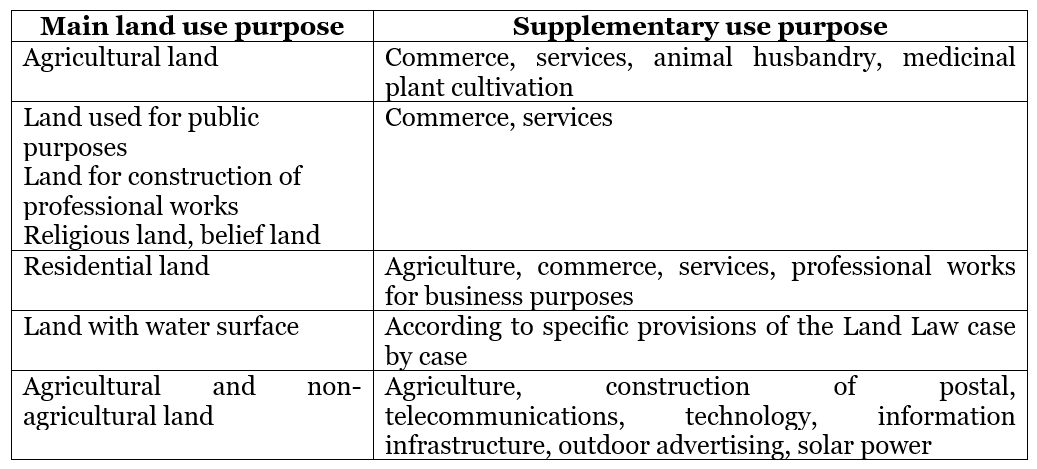
Specifically for housing, the Housing Law 2023 adds similar provisions on the permission to build and use in combination with other purposes, along with stricter requirements and conditions to ensure the main purpose of housing use[5]. Specifically, lawmakers require clear determination of the use purpose at the step of applying for project approval; issues related to the design and construction of functional areas to ensure operation; and require synchronized technical and social infrastructure within and outside the project scope.

One of the real estate products directly benefiting from this open policy is Condotel (tourist apartments), Officetel (office apartments), etc. The development of these real estate products currently faces obstacles in issuing Land Use Right Certificates for a long time, recently resolved by Decree 10/2023/ND-CP regulating the issuance of certificates for construction works used for tourist accommodation purposes according to tourism law regulations on commercial and service land, and Official Letter 3382/BTNMT-DD of the Ministry of Natural Resources and Environment dated May 15, 2023, on issuing certificates for two cases: construction works on non-agricultural land that is not residential land (with a time limit); and mixed-use apartment buildings built on residential land, where part is used for mixed purposes (long-term). However, the Land Law 2024 and Housing Law 2023 only address the situation of Condotels and Officetels on residential land and have not provided guidance for cases built on other land types, while these products are mainly developed on commercial and service land.

Nevertheless, with this newly added regulation along with conditions and requirements considered very detailed and specific, the use of land and structures on land will become more flexible and diverse, contributing significantly to increasing land use efficiency in the context of very diverse actual land use needs while still ensuring construction order, fire prevention and fighting, environment, and security and social order.

[1] Article 28.1, Land Law 2024

[2] Article 23.5, REB Law 2023

[3] Article 26 REB Law 2023

[4] Article 218 Land Law 2024

[5] Article 33 Housing Law 2023

Download the PDF version of this article here.

(VN) Specific Regulations on Commercial Housing Projects

On August 1, 2024, the three most pivotal legal documents within Vietnam’s real estate legal framework, namely the Land Law 2024, the Real Estate Business Law (“REB Law“) 2023, and the Housing Law 2023, came into effect. Together with certain related provisions in the Credit Institutions Law 2024, these laws are set to significantly impact the real estate market in Vietnam.

Vilasia, in collaboration with The Saigon Times, is pleased to present a series of analytical articles by Vilasia’s Nhung Nguyen on the most noteworthy new regulations in these four legal documents. The series will focus on six main topics:

(i) Methods for determining land rent and land use fees;
(ii) Conditions and procedures for transferring real estate projects;
(iii) Specific regulations on commercial housing projects;
(iv) Specific regulations on industrial park projects;
(v) Implementation of projects in the form of subdividing land lots for sale; and
(vi) Expansion of business scope for enterprises with foreign investment.

Below is the third in the series entitled “Specific regulations on commercial housing projects”, originally published in Vietnamese in The Saigon Times on August 8, 2024. The digital version is available here.

Bai 3

(EN) Real Estate Project Transfer

The Vietnamese version is available here.

Click here to download the PDF version.

On August 1, 2024, the three most pivotal legal documents within Vietnam’s real estate legal framework, namely the Land Law 2024, the Real Estate Business Law (“REB Law“) 2023, and the Housing Law 2023, came into effect. Together with certain related provisions in the Credit Institutions Law 2024, these laws are set to significantly impact the real estate market in Vietnam.

Vilasia, in collaboration with The Saigon Times, is pleased to present a series of analytical articles by Vilasia’s Nhung Nguyen on the most noteworthy new regulations in these four legal documents. The series will focus on six main topics:

(i) Methods for determining land rent and land use fees;
(ii) Conditions and procedures for transferring real estate projects;
(iii) Specific regulations on commercial housing projects;
(iv) Specific regulations on industrial park projects;
(v) Implementation of projects in the form of subdividing land lots for sale; and
(vi) Expansion of business scope for enterprises with foreign investment.

Below is the second in the series entitled “Real Estate Project Transfer”, originally published in Vietnamese in The Saigon Times on August 1, 2024. The digital version is available here.

____________________________

The conditions and procedures for transferring real estate projects, inherited from the REB Law 2014, have several notable new points as analyzed below.

Elimination of mandatory land use right certificate requirement for real estate project transfers

The transferor is required to fulfill all financial obligations related to the land of the project, including land use fees, land rent, and various taxes, fees, and charges related to the land[1]. Upon the completion of transfer procedure the fulfillment of these financial obligations related to the transfer transaction are fulfilled, the transferee shall then be issued the land use right certificate. Practically, from the time that the financial obligations related to the land are fulfilled, it usually takes several months for the investor to receive the land use right certificate and to take handover of the land on-site. Therefore, the elimination of this procedural step will save both parties a considerable amount of time and cost, which is significant for investors, especially as investment laws become increasingly stringent regarding project implementation timelines.

From the State’s perspective, even though the transferring investor has not yet completed the procedure to apply for the land use right certificate for the transferred land area, the fulfilment of financial obligations related to the land, including land use fees, land rent, and various taxes, fees, and charges demonstrates the financial capacity of the investor and ensures the fulfilment of the State’s revenue collection duties.

This new regulation is a positive, reasonable, and practical step forward, clearly reflecting the State’s efforts to simplify administrative procedures. It is anticipated to expedite the real estate project transfer process, thereby benefiting all parties involved.

Addressing procedural conflicts related to land when transferring real estate projects

Currently, the REB Law 2014 and Decree 43/2014/ND-CP, which guides the Land Law 2013 (“Decree 43“), use different criteria to classify administrative land procedures in the case of real estate project transfers.

Decree 43 bases its criteria on the form of land rent and land use fee[2]:

  • For projects using land under the form of land allocation with payable land use fee and one-time land rent for the entire lease period, and the payment does not originate from the state budget, the land use rights transfer procedure is carried out immediately from the transferor to the transferee;
  • For projects using land under the form of land allocation without land use fees or annual land rent: After approval for the transfer of the real estate project, the State will revoke the land from the transferor and lease/allocate the land to the transferee within the transferred project area.

In contrast, the REB Law 2014 classifies based on the land user:

  • Foreign-invested enterprises receiving the transfer of a real estate project: The procedure applies similarly to the case of “Projects using land with annual land rent as mentioned above;
  • The REB Law 2014 does not specify procedures for other subjects, such as domestic economic organizations[3].

This conflict is evident when a foreign-invested enterprise receives a real estate project transfer where the land use rights were allocated with payable land use fees or one-time land rent. In such cases, it is unclear whether the State revokes the land from the transferor and grants it to the transferee according to the REB Law 2014, or if the land use rights transfer procedure is carried out immediately from the transferor to the transferee as guided by Decree 43?

The REB Law 2023 resolves this issue by totally referring to the Land 2024 Law without providing a separate procedure in the REB Law 2013. However, the REB 2023 Law retains the previous structure, mentioning only the land procedures applicable to foreign-invested enterprises while remaining silent on similar procedures applicable to domestic enterprises or other land users.

Since it refers to the Land Law 2024, but this law has not yet specified the procedures, it is necessary to follow the Decrees guiding the Land Law 2024 to determine the applicable procedures.

Changes in Policies for Exemption and Reduction of Land Rent/Land Use Fees in M&A

Under the Land Law 2024, domestic organizations allocated land with land use fees and those paying land rent under the form of one-time payment for the entire lease period must repay any previously exempted or reduced land rent/land use fees upon transferring land use rights or contributing capital with land use rights.  This obligation to repay previously received exemptions or reductions must now be accounted for in real estate project transfer transactions.  This regulation marks a significant shift in policy and applies to both domestic organizations and foreign-invested economic organizations.[4]

Furthermore, a more favorable regulation has been introduced for land users. Those exempt from land use fees or land rent are no longer required to complete a separate procedure to request the exemption[5]. Previously, land users were obligated to carry out procedures to determine the exemption amount immediately after receiving a decision on land allocation or land lease. This process involved substantial time to determine land prices, particularly in cases where a specific land price is applicable rather than the local land price table. It is only after the state agency completes this determination that the amount of land rent or land use fees eligible for exemption or reduction is finalized, allowing the land user to proceed with subsequent procedures.

No exceptions for Credit Institutions transferring real estate projects to recover debts.

The REB Law 2023 does not address this issue, reflecting a perspective that this is not considered a specialized real estate business activity but merely a debt recovery activity specific to credit institutions. Therefore, this matter is governed by law on Credit Institutions and the laws on secured asset disposal. Specifically, the Credit Institutions Law 2024 provides for the right to transfer real estate projects in Article 200.

However, contrary to the expectations of many investors and real estate experts, Article 200 of the Credit Institutions Law 2024 does not specify unique conditions for this particular activity of credit institutions. Instead, it refers to the conditions for transferring real estate projects stipulated in the REB Law 2023. As a result, credit institutions transferring real estate projects to recover debt must adhere to the same stringent conditions applicable to all real estate project transfers by investors and real estate businesses, without any special exemptions or preferential treatment.

Notably, Resolution 42/2017/QH14 provided for more lenient conditions for project transfers, aiming to facilitate the disposal of secured assets for debt recovery by credit institutions. Specifically, it allowed for simpler, more streamlined requirements, such as: the project being approved; having a decision on land allocation or land lease; no disputes over land use rights; no seizure, and no land recovery decision. More stringent conditions, such as the completion of detailed planning, compensation, support and resettlement; technical infrastructure, and particularly land-related financial obligations, were waived[6].

This lenient regulation received widespread support from investors and real estate experts, significantly improving the efficiency of bad debt management in the banking sector

During the process of amending the REB Law 2023, there were numerous suggestions to extend these pilot regulations on the disposal of secured assets by credit institutions to general regulations on project transfers. The rationale was that transferring real estate projects could assist struggling investors, and transferring projects in their existing state would enable capable investors to continue development. Thus, the legal conditions should focus on basic requirements without mandating the completion of financial obligations related to the land.

However, from a regulatory perspective, stringent conditions for transferring real estate projects help prevent the speculative trading of real estate projects. This ensures that investors conduct thorough research and preparation, including financial readiness, before committing to a project, thereby avoiding abandoned projects that waste land resources and miss opportunities for capable investors.

Nonetheless, the Credit Institutions Law includes transitional provisions. Specifically, real estate projects accepted as secured assets before August 1, 2024, will only need to meet the more lenient conditions similar to those stipulated in Resolution 42. Meanwhile, for real estate projects accepted as secured assets from August 1, 2024, the new regulations will apply[7], requiring compliance with all stringent conditions applicable to all real estate project transfers.

[1] Article 40.3, REB Law 2023

[2] Article 83.2 Decree 43/2014/ND-CP

[3] Article 51.3 REB Law 2023

[4] Article 33.3(b) and Article 41.5 Land Law 2024

[5] Article 157.3 Land Law 2024

[6] Article 10 Resolution 42

[7] Article 200 Credit Institutions Law 2024

Download the PDF version of this article here.

(VN) Real Estate Project Transfer

On August 1, 2024, the three most pivotal legal documents within Vietnam’s real estate legal framework, namely the Land Law 2024, the Real Estate Business Law (“REB Law“) 2023, and the Housing Law 2023, came into effect. Together with certain related provisions in the Credit Institutions Law 2024, these laws are set to significantly impact the real estate market in Vietnam.

Vilasia, in collaboration with The Saigon Times, is pleased to present a series of analytical articles by Vilasia’s Nhung Nguyen on the most noteworthy new regulations in these four legal documents. The series will focus on six main topics:

(i) Methods for determining land rent and land use fees;
(ii) Conditions and procedures for transferring real estate projects;
(iii) Specific regulations on commercial housing projects;
(iv) Specific regulations on industrial park projects;
(v) Implementation of projects in the form of subdividing land lots for sale; and
(vi) Expansion of business scope for enterprises with foreign investment.

Below is the second in the series entitled “Real Estate Project Transfer”, originally published in Vietnamese in The Saigon Times on August 1, 2024. The digital version is available here.

Project Transfer (by Nhung Nguyen Vilasia) P2

(EN) Reformed Mechanism for Calculation and Application of Land Use Fees and Land Rent

The Vietnamese version is available here.

Click here to download the PDF version.

On August 1, 2024, the three most pivotal legal documents within Vietnam’s real estate legal framework, namely the Land Law 2024, the Real Estate Business Law (“REB Law“) 2023, and the Housing Law 2023, came into effect. Together with certain related provisions in the Credit Institutions Law 2024, these laws are set to significantly impact the real estate market in Vietnam.

Vilasia, in collaboration with The Saigon Times, is pleased to present a series of analytical articles by Vilasia’s Nhung Nguyen on the most noteworthy new regulations in these four legal documents. The series will focus on six main topics:

(i) Methods for determining land rent and land use fees;
(ii) Conditions and procedures for transferring real estate projects;
(iii) Specific regulations on commercial housing projects;
(iv) Specific regulations on industrial park projects;
(v) Implementation of projects in the form of subdividing land lots for sale; and
(vi) Expansion of business scope for enterprises with foreign investment.

Below is the first in the series entitled “Reformed Mechanism for Calculation and Application of Land Use Fees and Land Rent,” originally published in Vietnamese in The Saigon Times on July 25, 2024. The digital version is available here.

____________________________

Land rent will predominantly be paid annually, with limited opportunities to switch to a one-time payment scheme.

Following the policy of “Primarily implementing the annual land rent” as stated in Resolution No. 18-NQ/TW, Article 120 of the Land Law 2024 enumerates the limited cases where one-time land lease payments are permitted. For all other cases, annual land rent will apply. This represents a significant shift from the Land Law 2013, which allowed land users the option to choose between one-time or annual land rent under all circumstances.

Specially, one-time land lease payments are applicable only in the following four cases[1]:

  • Land used for agriculture, forestry, aquaculture and salt production projects;
  • Land used for industrial parks, industrial clusters, high-tech parks, and worker accommodation in industrial parks;
  • Land used for public and business purposes; commercial, service land used for tourism and office business activities;
  • Land used for the construction of rental social housing as per housing law regulations.

Notably, the case of Land used for public and business purposes; commercial, service land used for tourism and office business activitieshas garnered considerable attention and feedback from investors and legal experts. Initially, this case was not included in the draft law as one-time land lease payments, aligning with the spirit of Resolution 18. However, after multiple rounds of consultation and feedback, it became one of the key issues to be reviewed before the final draft was submitted to the National Assembly. This regulation is particularly significant for Condotel (condominium hotel) and Officetel (office apartments) developments on leased land, allowing investors to make a one-time land rent payment and fully exercise their land use rights.

Additionally, the Land Law 2024 only allows the conversion to annual land rent from one-time land rent and not vice versa.  In contrast, the Land Law 2013 allowed land users paying annually to switch to one-time payments during the land use period[2]. However, for industrial zone and cluster land, conversion from annual to one-time land rent is allowed without requiring conversion of the entire project area.

Foreign investors typically prefer one-time land rent to lock in lease costs upfront, avoiding land price volatility and inflation, and enjoying more comprehensive rights compared to annual land rent. Conversely, domestic investors, often with less financial capacity, opt for annual land rent to reduce financial burdens during the early stage of project development, despite more limited land use rights. However, annual land rent exposes investors to potential increases in land lease costs, which are expected to rise, especially as the Land Law 2024 removes the land price framework while the annual land price table adjustment is applicable as mentioned below. This could pressure investors holding large areas of land without sufficient financial capacity to develop projects, leading to the need for transfer to financially capable investors unwilling to invest time in project initiation.

Elimination of the Land Price Framework

The new law eliminates the land price framework, previously set for different land types and regions and remained stable for five years unless market prices changed by 20%. Local land price tables, which could not exceed regional price frameworks, also remained stable for five years.[3] The Land Law 2024 instead mandates annual adjustments to local land price tables, aligning them more closely with market prices and ensuring continuous updates.

This change means landowners whose land is acquired may receive higher compensation, potentially expediting the compensation and site clearance process—one of the most complex and time-consuming issues in real estate development. Conversely, the State rental price is expected to rise significantly, and although the Land Law 2024 ensures the stability of land rent within a 5-year cycle, with adjustments not exceeding the cumulative annual Consumer Price Index (CPI) of the previous 5 years[4], real estate investors must prepare for substantial increases in land rental costs over the project lifecycle.

Changes in Land Price Calculation Methods

Land valuation methods are clearly and specifically legislated, with four remaining methods: comparison, surplus, income, and the land price adjustment coefficient (the deduction method has been eliminated)[5].

Notably, the surplus method, initially excluded in early drafts of the Land Law 2024, was reinstated following widespread feedback from experts and investors. This method has been applied to nearly 90% of real estate projects since 2014, playing a key role in valuing potential land.

Immediately after the National Assembly’s issuance of the Land Law 2024 on January 18, 2024, Decree 12/2024/ND-CP was promptly issued on February 5, 2024, amending and supplementing certain provisions of Decree 44/2014/ND-CP on land valuation, incorporating the land valuation methods mentioned in the Land Law 2024. This swift action by the Government underscores the urgency in adjusting land valuation methods and implementing specific criteria for these methods.

Leasehold Rights – New Rights for Annual Land Rent Investors

“Leasehold rights in land lease contracts” is a novel term, defined as the rights of the land user arising when the State leases land in form of annual land rent. Land users are entitled to transfer the leasehold rights, and transferees inherit land user’s rights and obligations[6]. This broad definition has led to misunderstandings and controversies about the extent of the rights for annual land rent payers that can be inherited upon transfer.

However, Article 46 of the Land Law 2024 clarifies that leasehold rights in land lease contracts must be associated with assets on the land. Land users only acquire these rights if they meet all conditions for transferring land-attached assets (completed construction according to the plan, registered land use, etc.), along with a new condition of having prepaid compensation, support, and resettlement costs not yet deducted from lease payments.

Thus, land users do not have leasehold rights in land lease contracts until they complete construction on the land and register property ownership. Moreover, in case the prepaid compensation, support, and resettlement costs are fully deducted, the investors no longer possess these rights.

This new regulation addresses situations where real estate projects on annually leased land, with prepaid compensation, support, and resettlement costs gradually deducted, are transferred by investors before the deductions are fully made. The Land Law 2013 lacked provisions for handling such prepaid amounts. Under the new regulation, investors acquiring land-attached assets continue to benefit from the deduction during the remaining period that has not been deducted, and the state does not refund prepaid amounts to the initial investors.

This is an important consideration for investors during real estate project M&A processes. It is crucial to negotiate the value of the leasehold rights within the total transaction value and to include the lease-related rights and responsibilities in contract drafting and signing. Additionally, the Land Law 2024 recognizes leasing, mortgaging, and capital contributions of leasehold rights associated with land-attached assets in land lease contracts, significantly enhancing the value of land use rights and assets in various transactions.

[1] Article 120, Land Law 2024

[2] Article 172, Land Law 2013

[3] Article 113 and 114, Land Law 2013

[4] Article 153, Land Law 2024

[5] Article 128.5, Land Law 2024

[6] Article 3.37, Land Law 2024

Download the PDF version of this article here.

(VN) Reformed Mechanism for Calculation and Application of Land Use Fees and Land Rent

On August 1, 2024, the three most pivotal legal documents within Vietnam’s real estate legal framework, namely the Land Law 2024, the Real Estate Business Law (“REB Law“) 2023, and the Housing Law 2023, came into effect. Together with certain related provisions in the Credit Institutions Law 2024, these laws are set to significantly impact the real estate market in Vietnam.

Vilasia, in collaboration with The Saigon Times, is pleased to present a series of analytical articles by Vilasia’s Nhung Nguyen on the most noteworthy new regulations in these four legal documents. The series will focus on six main topics:

(i) Methods for determining land rent and land use fees;
(ii) Conditions and procedures for transferring real estate projects;
(iii) Specific regulations on commercial housing projects;
(iv) Specific regulations on industrial park projects;
(v) Implementation of projects in the form of subdividing land lots for sale; and
(vi) Expansion of business scope for enterprises with foreign investment.

Below is the first in the series entitled “Reformed Mechanism for Calculation and Application of Land Use Fees and Land Rent,” originally published in Vietnamese in The Saigon Times on July 25, 2024. The digital version is available here.

New Real Estate Business Laws (by Nhung Nguyen Vilasia) P1

Members of the Board of Directors under the New Credit Institutions Law

The 2024 Credit Institutions Law comes into effect on 1 July 2024. Compared to the 2010 Credit Institutions Law, in addition to changes related to the business activities of credit institutions (CIs), the new law also adjusts regulations concerning the members of the Board of Directors (BoD) and the board itself.

Higher standards for election and appointment of BoD members

 Article 41 of the 2024 Credit Institutions Law allows the Governor of the State Bank of Vietnam (SBV) to set requirements for the professional ethics standards of BoD members in CIs. This is in line with international standards. For instance, the Prudential Practice Guide[1] by the Australian Prudential Regulation Authority (APRA) for members of BoD in Authorized Deposit-Taking Institutions focuses on establishing ethical standards through four main elements: integrity, fairness, honesty, and independence. In Vietnam, these rules are currently being prepared by the SBV, so CIs need to follow further instructions in the coming time.

Moreover, the new law adds the condition of “having at least 5 years of direct work experience in the professional department of a credit institution or a foreign bank branch” as one of the conditions to become a BoD member.[2] As a result, a person with at least 5 years as an executive of another business (outside the banking sector) will not be considered eligible to become a BoD member. This is a point that CIs need to note to ensure compliance when selecting corresponding titles as well as to amend relevant content in their internal documents such as charters and operational regulations.

In addition, the 2024 Credit Institutions Law also adds requirements for independent members of the BoD. In particular, (i) they must not represent the ownership of shares in that CI, and (ii) neither they nor their related persons may own directly or indirectly from 1% of the charter capital or voting shares or more.[3] Both of these regulations change in a more stringent direction to ensure the independence and transparency of independent BoD members in the operation of CIs. Specifically, the 2010 Law on Credit Institutions only restricted cases of direct, indirect ownership or representation of ownership from 1% or more of the charter capital or voting shares, or only restricted cases of joint ownership with related persons from 5% or more.[4] Note that the 2024 Credit Institutions Law has also adjusted to expand the definition of “related persons” For instance, it clarifies situations involving parents, children, and siblings to include adoptive parents, stepfathers, and stepmothers.[5] This adjustment will have a significant impact on the operations of CIs as the content about related persons is intertwined in many regulations in banking activities. For example, in credit granting activities, it is necessary to collect information about related persons and control the credit limit for customers and related persons.

Additional conditions restricting holding positions for BoD members

 Besides setting higher standards for the appointment of BoD members, the 2024 Credit Institutions Law also adds restrictions for BoD members in holding their positions. Accordingly, the BoD chairman cannot concurrently be a member of the control board of that CI and another CI.[6] This can help limit potential conflicts of interest in practice. In addition, the 2024 Credit Institutions Law has divided the regulation of not holding concurrent positions for BoD members into two main groups: (i) executives of other CIs and managers of other enterprises are not allowed to be BoD members (except for certain exemptions) for non-independent BoD members, and (ii) managers of two or more other enterprises are now also not eligible to become independent BoD members.[7] These changes align with the goal of the law amendment, which is to further enhance the governance and management capabilities of Cis.

Narrowing the authorization mechanism

 There are two main points regarding authorization related to BoD members that are adjusted and supplemented in the 2024 Credit Institutions Law, including:

  • The BoD chairman is only allowed to authorize another BoD member to exercise the rights and duties of the BoD chairman during his/her absence or inability to perform duties.[8] Imposing more conditions for authorization helps to align with the provisions of the 2020 Law on Enterprises.
  • BoD members are not allowed to authorize others to attend BoD meetings to decide on content related to several matters such as: (i) approving the plan to contribute capital, purchase shares or capital contributions of the CI in enterprises or other CIs where the estimated capital contribution value, purchase price or book value in case of selling shares or capital contributions is below 20% of the charter capital of the CI recorded in the most recent audited financial statements or a lower ratio as specified in the Charter, or (ii) approving other contracts or transactions with a value of 10% or more of the charter capital of the CI recorded in the most recent audited financial statements or a lower ratio as specified in the Charter.[9] It can be seen that almost all important issues now cannot be authorized to decide but must be directly carried out by BoD members.

In short, the 2024 Credit Institutions Law brings many important changes for the BoD to increase transparency, accountability, and management efficiency, while ensuring that credit institutions operate in accordance with international standards, enhancing the stability and safety of the financial system.

[1] “Prudential and Reporting Standards for Authorised deposit-taking institutions”, wesite: Prudential and Reporting Standards for Authorised deposit-taking institutions | APRA.

[2] Article 41.1 Law on Credit Institutions 2024

[3] Article 41.2 Law on Credit Institutions 2024

[4] Article 50.2 Law on Credit Institutions 2010

[5] Article 4.24 Law on Credit Institutions 2024

[6] Article 43.1 Law on Credit Institutions 2024

[7] Article 43.2 Law on Credit Institutions 2024

[8] Article 71.10 Law on Credit Institutions 2024

[9] Article 72.5 Law on Credit Institutions 2024

New Points of the Electronic Transactions Law Impacting the Banking Sector

In 2023, the 5th session of the 15th National Assembly ratified the Law on Electronic Transactions (amended), which will take effect from July 1, 2024 (Law on E-Transactions 2023), replacing the Law on Electronic Transactions 2005 (Law on E-Transactions 2005). Changes in the Law on E-Transactions 2023 will have particular impacts on the operations of commercial banks in the current “digitalization” context. Therefore, having specific assessments and adjustments is essential to ensure compliance in credit institutions (CIs). In the scope of this article, the writer would only mention two new points of the Law on E-Transactions 2023 that, in point of view, might have a crucial impact on the banking industry.

Electronic signature

Generally, in addition to supplementing the definition of electronic signatures and affirming the legal value of electronic signatures, the Law on E-Transactions 2023 has classified electronic signatures into: (i) special-use e-signatures, and (ii) digital signatures (including public digital signatures, civil service digital signatures).[1] The new law also has stricter requirements when specialized electronic signatures used to ensure safety need to be certified by the Ministry of Information and Communications.[2] In contrast, previously, the security only needed to be verified according to the process is agreed upon and proven by the parties, and meets the minimum requirements of the law.[3]

The changes regarding electronic signatures may significantly impact the operations of CIs when there are many related regulations that require signatures from both CIs and customers. For instance, the signature of the legal representative of the credit institution is required in the guarantee agreement and guarantee commitment.[4] Or, when entering into an agreement to open and use a payment account with an institutional customer, the law requires banks to verify the signature, seal (if any), and digital certificate (if any) of the legal representative of clients.[5]

Consequently, while waiting for the Law on E-Transactions 2023 to take effect, as well as the Government’s decrees and/or guidance from the State Bank of Vietnam (SBV) related to this issue, CIs can consider implementing the following measures to ensure compliance in their operations and avoid delays in transactions with customers:

  • Review processes related to signing and/or verifying through electronic means to require customers to implement appropriate transitions, such as using digital signatures for transactions or registering specialized electronic signatures with the Ministry of Information and Communications to be recognized as safe signatures.[6]
  • Review internal regulations (processes, systems, forms, products) related to electronic signatures or activities requiring customers to sign and/or verify for amendments, updates and supplemented (if necessary) to be compatible with the Law on E-Transactions 2023. During the update process, CIs should also pay attention to recent SBV guidelines related to this issue, such as Decision No. 2345/QD-NHNN on implementing security measures in online payment and card payment by the Governor of the State Bank of Vietnam (this is an important document replacing Decision 630/QD-NHNN in 2017 related to authentication methods).
  • According to transition provisions, e-transactions established before 1 July 2024 but not yet implemented by 1 July 2024 would continue to comply with the regulations of the Law on E-Transactions 2005, unless the parties agree to apply the regulations of the Law on E-Transactions 2023.[7] Therefore, CIs might need to pay attention to review current transactions, then classify and determine the time to complete the transaction to suitable notice for customers.

In addition, the Law on E-Transactions 2023 allows the use of other authentication forms excluding e-signatures by electronic means to show signatories’ approval for data messages shall comply with other regulations of relevant laws.[8] However, as detailed guidance on which “other regulations” is not yet available for now, CIs should monitor further guidelines to make appropriate adjustments to the operations.

Information system serving electronic transactions and electronic transaction accounts

These regulations are all new to the Law on E-Transactions 2023 compared to the Law on E-Transactions 2005. In accordance with information systems serving e-transactions, CIs are required to classify information systems serving electronic transactions according to the following criteria such as: administrator, functions, and features of the information system serving e-transactions; size, number of users in Vietnam or monthly access numbers from users in Vietnam.[9] Additionally, a new draft decree on information systems serving e-transactions was also discussed at the 4th session of the 15th National Assembly. Therefore, CIs should note these criteria when classifying information systems. At the same time, it is necessary to follow additional detailed instructions and regulatory documents from the relevant Government to ensure compliance.

For electronic transaction accounts, the Law on E-Transactions 2023 allows the transaction history of an e-transaction account to be used to prove the transaction history of participating parties when meeting the following conditions:[10]

  • The information system serving the e-transaction must ensure its safety in accordance with the law on information security;
  • Uniquely linked to an agency, organization, or individual as the owner of the e-transaction account; and
  • Ensure accurate transaction time from the time source as regulated by the national standard time law.

Therefore, relevant departments of CIs need to coordinate implementation on the basis of other relevant legal regulations such as the Law on Cyber Information Security 2015 and the  Cybersecurity Law 2018 to review the systems that create electronic trading accounts to synchronize and standardize transaction history in order to: (i) minimize the risk customer personal information loss, and (ii) ensure the integrity and security of data in the electronic trading environment. Having a suitable and standardized transaction history can also help CIs reduce costs and the burden of proof in the event of actual disputes. This, in turn, enhances transparency as well as efficiency in resolving disputes and debt recovery at CIs.

It is clear that the Law on E-Transactions 2023 with many comprehensive changes would be an important legal basis in implementing the transformation of activities from the conventional environment to the digital environment, and including banking activities. Therefore, proactively updating, reviewing and adjusting internal processes and related systems not only helps CIs quickly meet legal conditions but is also an opportunity to increase the competitiveness of its products in the market via a digital transformation model.

[1] Article 22 Law on Electronic Transactions 2023

[2] Article 25.2 Law on Electronic Transactions 2023

[3] Article 22.1 Law on Electronic Transactions 2005

[4] Article 17.1 Circular 11/2022/TT-NHNN

[5] Article 14.3 Circular 16/2020/TT-NHNN

[6] Article 25 Law on Electronic Transactions 2023

[7]Article 53.1 of the Law on Electronic Transactions 2023

[8]Article 22.4 of the Law on Electronic Transactions 2023

[9]Article 45.1 of the Law on Electronic Transactions 2023

[10]Article 46.4 of the Law on Electronic Transactions 2023

New Amendments in Circular 19 about Regulations on Conditions for Foreign Loans

Click here to download the PDF version.

INTRODUCTION 

Recently, the State Bank of Vietnam (SBV) has issued Circular No. 19/2024/TT-NHNN (“Circular 19”) effective from July 1, 2024, to amend and supplement certain regulations in Circular No. 08/2023/TT-NHNN (“Circular 08”) regarding conditions for foreign loans without government guarantees. According to this, the significant changes include the SBV (i) recognizing foreign loans arising from letters of credit, (ii) adding conditions related to foreign loans for the payment of deferred import contracts, and (iii) clarifying on loan purposes and limits.

Key Takeaways from Circular 19:

1. Recognition of Foreign Loans from Letters of Credit: SBV now recognizes foreign loans from letters of credit, facilitating transactions and validating this form of credit-granting as a cross-border service.

2. Conditions for Deferred Import Payment Loans: SBV also adds conditions for foreign loans used for deferred import contracts, ensuring consistent application across SBVs and excluding these loans from foreign loan limits.

3. Clarification on Loan Purposes and Limits: Due to the supplementation of Foreign Loans from Letters of Credit mentioned above, Circular 19 clarifies the purposes of foreign loans, adding a new purpose for payment to beneficiaries in the issuance of deferred payment letters of credit.

MAIN AMENDMENTS

Recognizing foreign loans arising from letters of credit[1]

According to the WTO commitments, Vietnam does not commit to financial and banking services (including letters of credit issuance) in the form of cross-border service provision.[2] Except for guarantees and loans, which are two credit-granting activities indirectly recognized through SBV documents, the legal framework for credit-granting activities by foreign banks has previously been unclear. Prior to Circular 19, in transactions involving debt arising from letters of credit, parties typically needed to sign a loan agreement to legitimize the loan that the issuing bank paid to the beneficiary under the signed letter of credit. Recognizing foreign loans arising from letters of credit provided a basis for the Vietnamese borrowers to transfer this amount abroad. Therefore, the supplementation by the SBV aligns with practical needs, facilitates transactions for the involved parties, and indirectly acknowledges this form of credit-granting under the form of the cross-border service provision.

In addition, the recognition of such loans also leads to adjustments which will be discussed below.

Adding conditions related to foreign loans for the payment of import contracts of goods[3]

This type of loan has been recognized since 1999 and has undergone several amendments and adjustments by the SBV. However, this addition to Circular 19 is one of the most significant adjustments due to the following reasons:

  • It unifies the understanding of the foreign loan limits for borrowers, such as manufacturers, who utilize deferred payment import contracts.[4] According to Circular 19, outstanding medium and long-term foreign loans arising from this form will not be included in the foreign loan limits. This ensures consistent application across local SBVs when handling similar cases.
  • The added condition of the imported goods must be used for the purpose of the implementation of the investment project, the business plan or other projects of the borrowers.[5] This regulation is more stringent as SBVs can now assess the “relevance” of imported goods to the borrower’s investment project.

Furthermore, the borrower can exclude medium and long-term foreign loan balances arising from deferred payment import contracts when calculating the foreign loan limit.

Clarifying (i) the purpose of foreign loans, and (ii) the limit on short-term foreign loans for borrowers who are credit institutions or branches of foreign banks[6]

As mentioned earlier, the recognition of foreign loans arising from letters of credit also leads to adjustments regarding the purpose of foreign loan agreements. In particular, Circular 19 supplements a new purpose – payment to the beneficiary in the issuance of deferred payment letters of credit with immediate or pre-maturity payment terms and other business activities related to letters of credit. In this case, the borrower may not need to prove the purpose of the foreign loan in the registration/change registration dossier submitted to the SBV.[7]

SBV also extends the prudential ratio for borrowers who are credit institutions or branches of foreign banks. This is because Circular 19 clarifies that the limit on short-term foreign loans (e.g. 30% for commercial banks) will not apply in the case of foreign loans arising from the issuance of letters of credit-by-credit institutions or branches of foreign banks.[8]

CONCLUSION

Overall, the adjustments in Circular 19 revolve around the addition of loans arising from letters of credit. The amendments and supplements to Circular 08 are necessary, especially given the Government’s schedule to open up the market and the increasing competition in the international trade market. These changes address practical issues, facilitate the flow of international capital, and are particularly important in the context of the current global recession.

[1] Circular 19, Article 1.1.

[2] Vietnam’s WTO Commitments (on Services), Mode of delivery (1) Cross-border service, Section B, Part 7.

[3] Circular 19, Article 1.2.

[4] Circular 19, Article 1.2.

[5] Circular 19, Article 1.2.

[6] Circular 19, Article 1.5.

[7] Circular 19, Article 1.4.

[8] Circular 19, Article 1.6.

Download the PDF version of this article here.

Contact Us
Email Us

For detailed inquiries, please email us at info@vil.asia.

Call Us

For quick questions or to arrange a meeting, feel free to call us at: (+84) 286 270 8696.

Meet Us in Person

Please visit us at:

Ho Chi Minh City

Aqua 1, Vinhomes Golden River, 2 Ton Duc Thang, Sai Gon Ward

Hanoi

11th Floor, Heritage West Lake Building, 677 Lac Long Quan, Tay Ho Ward