(VN) Condominium Maintenance Fund: Debates Surrounding the New Regulations on Revenue Sources

On August 1, 2024, a new regulation regarding revenue from shared ownership areas in condominiums came into effect, sparking a series of debates among various stakeholders. This regulation, introduced by the 2023 Housing Law, aims to streamline and ensure transparency in managing condominium maintenance funds. The implementation, however, has led to differing interpretations and approaches from property managers, developers, and residents alike.

Vilasia, in collaboration with The Saigon Times, presents an insightful article by Nhung Nguyen analyzing the controversies surrounding the new regulation on condominium maintenance fund revenue. Below is the full article, originally published in Vietnamese in The Saigon Times on October 10, 2024. The digital version is available here.

Condominium maintenance fund Debates surrounding the new regulations on revenue sources

(EN) Vietnam’s Real Estate Market and the Land Price Adjustment Equation

The Vietnamese version is available here.

Click here to download the PDF version.

On August 1, 2024, Vietnam’s real estate market saw major shifts with the implementation of the Land Law 2024. In response, local governments now face the challenge of adjusting land price tables to align with new legal frameworks and market realities. This process, however, has sparked significant debate among stakeholders, especially regarding the balance between fiscal responsibility and public affordability.

Vilasia, in collaboration with The Saigon Times, is proud to present an in-depth analysis by Nhung Nguyen, focusing on the intricate legal aspects of land price adjustments. Below is the last article in the series titled “Vietnam’s Real Estate Market and the Land Price Adjustment Equation,” originally published in Vietnamese in The Saigon Times on September 19, 2024. The digital version is available here.

____________________________

After the 2024 Land Law takes effect, localities across the country are facing the challenge of adjusting land price tables to comply with new regulations and market realities, a complex task with many legal challenges and conflicting reactions from involved individuals and organizations.

Real-life Stories

Ho Chi Minh City is the first locality to implement procedures for adjusting land price tables. However, the proposed adjusted land price table has faced strong opposition from citizens and organizations. Many opinions argue that the land price adjustment is too high – increasing by an average of 5-10 times, with some areas in Hooc Mon district increasing up to 50 times – which will become a burden for people in fulfilling land-related financial obligations, especially in cases where people are carrying out procedures for recognizing land use rights and converting land use purposes. From the management aspect, the Ho Chi Minh City Tax Department argues that applying the current land price table, which is much lower than the market price but without the land price adjustment coefficient (K coefficient), will result in lower tax revenue for the state budget, causing the tax authority to worry about being accused of budget loss[1]. The Ho Chi Minh City Tax Department has temporarily suspended processing submitted dossiers determining land-related financial obligations until there are more specific guidelines from the Ministry of Natural Resources and Environment and the Ho Chi Minh City People’s Committee. According to statistics, more than 8,800 land dossiers have been backlogged within one month since the new law took effect as the tax authority is still waiting for guidance on the new tax calculation method.

Meanwhile, in Hanoi, the real estate market is also witnessing many fluctuations, especially after land auctions in suburban districts like Thanh Oai and Hoai Duc. The winning bid prices for land plots in these areas have reached over 130 million VND/m², much higher than the starting prices and also considered much higher than market values. The reason is believed to be due to the very low starting prices in the auctions (currently applied according to the land price table issued under the 2013 Land Law and guiding documents), creating conditions for some speculative groups to take advantage and push prices up, causing market disturbance. Previously, Hanoi had not made any moves to adjust the current land price table.

Shortcomings in Legal Regulations Related to Land Price Tables

Clause 1, Article 257 of the 2024 Land Law stipulates that the current land price table can still be used without mandatory adjustment until January 1, 2026. However, there are currently the following shortcomings:

The 2013 Land Law and Decree 44/2014/ND-CP on land prices limit the cases of using land price tables to determine financial obligations; instead, the adjustment coefficient method is applicable, which means multiplying the adjustment coefficient with the price in the land price table to get the specific land price. In the 2024 Land Law, the cases of using land price tables are expanded in the context of eliminating the land price framework and stipulating annual updates of land price tables to closely follow market prices. Then, some cases that previously used the land price adjustment coefficient method will now apply the land price table. The case of households and individuals being recognized for land use rights, converting land use purposes exceeding the limit is an example.

As of August 1, 2024, the new law no longer stipulates the K coefficient but allows continued use of the current land price tables. This leads to the consequence that the state budget revenue from cases determining financial obligations based on the land price table will be reduced many times. Moreover, the state budget may suffer even more losses due to the expansion of cases applying the land price table.

Along with the policy of continuing to use the current land price table, Clause 1, Article 257 of the 2024 Land Law also allows the provincial People’s Committees to decide to adjust the land price table according to the provisions of this Law to suit the actual situation of land prices in the locality, but it is specified as “in necessary cases”. Thus, adjusting the land price table is not mandatory and not every locality needs to adjust.

However, after the land auctions in suburban districts of Hanoi, the Ministry of Natural Resources and Environment issued Official Letter No. 5774/BTNMT-QHPTTNĐ dated August 23, 2024, with the content: “…requesting the People’s Committees of provinces and cities directly under the Central Government, when applying land prices in the land price table for land management work, to direct a review, in case the area or location needs to apply the land price table but the land price is not suitable with reality, then based on legal regulations and the actual situation of the locality to decide to adjust the land price table issued by the provincial People’s Committee according to the 2013 Land Law in that area or location to apply until the end of December 31, 2025.”. This request from the Ministry of Natural Resources and Environment is aimed at preventing behaviors that take advantage of land use right auctions for profit, causing market disturbance. However, it may cause a series of localities to adjust land price tables to reflect market prices. It is worth noting that if localities decide to suddenly increase land prices many times as in the draft of Ho Chi Minh City, it will no longer be in line with the spirit of the new law, which currently allows a preparation period extending to early 2026.

The Equation of Balancing Interests

As analyzed above, the lack of clarity in the transitional provisions in Clause 1, Article 257 of the 2024 Land Law is considered the main cause of the current complicated situation. Therefore, having early guidance and direction from the competent authorities to overcome this shortcoming will ensure that the transitional provisions are implemented in practice. Accordingly, the current land price tables can be applied until the end of 2025 to allow people, businesses, and state authorities a period of time to prepare for implementation according to the new land prices, except for truly necessary cases.

In truly necessary cases, the adjustment of the current land price table also needs to be calculated to ensure harmony between the needs and interests of entities participating in the real estate market. The goal is not only the suitability of the land price table with market land prices but, most urgently, to consider the impact of this adjustment on social life. Accordingly, the adjustment needs to take into account different groups of subjects and levels of priority and protection, such as non-business citizens and real estate business groups. At the same time, it is necessary to prevent profiteering, market disturbance, ensure budget revenue, but also encourage and create conditions to develop the real estate market to solve the current supply shortage.

To build a harmonious and reasonable land price table, the participation and feedback from a wide range of social components is extremely important. In Ho Chi Minh City, one of the highly appreciated moves is the Department of Natural Resources and Environment issuing Document No. 7635/STNMT-KTĐ dated August 1, 2024, on providing information related to adjusting the Land Price Table in the city, which requests related agencies to publish a summary table of explanations related to adjusting the land price table, along with the proposed adjusted land price table. This widespread provision of information creates conditions for a large number of people, businesses, and organizations to participate in giving feedback. And a civilized society, built and operated for the people, very much needs voices from many different perspectives, where the voices of the people are listened to, acknowledged, and absorbed as the most practical measure.

[1] See “Ho Chi Minh City Tax Department proposes to resolve land files”, published on Vnexpress.net, https://vnexpress.net/thue-tp-hcm-kien-nghi-khan-giai-quyet-ho-so-dat-dai-4789234.html (accessed on September 9, 2024).

(VN) Vietnam’s Real Estate Market and the Land Price Adjustment Equation

On August 1, 2024, Vietnam’s real estate market saw major shifts with the implementation of the Land Law 2024. In response, local governments now face the challenge of adjusting land price tables to align with new legal frameworks and market realities. This process, however, has sparked significant debate among stakeholders, especially regarding the balance between fiscal responsibility and public affordability.

Vilasia, in collaboration with The Saigon Times, is proud to present an in-depth analysis by Nhung Nguyen, focusing on the intricate legal aspects of land price adjustments. Below is the last article in the series titled “Vietnam’s Real Estate Market and the Land Price Adjustment Equation,” originally published in Vietnamese in The Saigon Times on September 19, 2024. The digital version is available here.

Vietnam's real estate market and the land price adjustment equation

(EN) Expanding the Business Scope of Enterprises with Foreign Investment Capital

The Vietnamese version is available here.

Click here to download the PDF version.

On August 1, 2024, the three most pivotal legal documents within Vietnam’s real estate legal framework, namely the Land Law 2024, the Real Estate Business Law (“REB Law“) 2023, and the Housing Law 2023, came into effect. Together with certain related provisions in the Credit Institutions Law 2024, these laws are set to significantly impact the real estate market in Vietnam.

Vilasia, in collaboration with The Saigon Times, is pleased to present a series of analytical articles by Vilasia’s Nhung Nguyen on the most noteworthy new regulations in these four legal documents. The series will focus on six main topics:

(i) Methods for determining land rent and land use fees;
(ii) Conditions and procedures for transferring real estate projects;
(iii) Specific regulations on commercial housing projects;
(iv) Specific regulations on industrial park projects;
(v) Implementation of projects in the form of subdividing land lots for sale; and
(vi) Expansion of business scope for enterprises with foreign investment.

Below is the last in the series entitled “Expanding the business scope of enterprises with foreign investment capital”, originally published in Vietnamese in The Saigon Times on August 29, 2024. The digital version is available here.

____________________________

Some “hybrid” enterprises will be allowed to conduct real estate business like “pure Vietnamese” enterprises

The REBL 2023 and the Land Law 2024 have made important adjustments for enterprises with foreign investment capital.

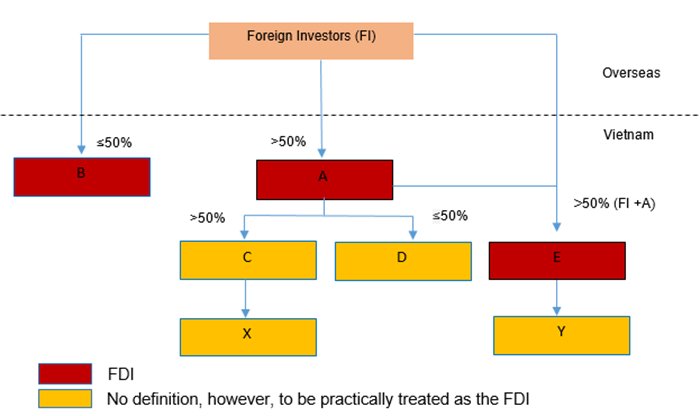
According to current regulations, the REBL 2014 only uses the term “enterprise with foreign investment capital” but does not have a specific definition, there is no distinction regarding the ownership ratio of foreign investors, whether high or low, and there is no reference clause to laws on investment. Regarding land, the Land Law 2013 defines: “Enterprises with foreign investment capital include 100% foreign-invested enterprises, joint ventures, Vietnamese enterprises in which foreign investors buy shares, merge, or acquire according to investment law regulations[1]. With this description, all entities from 100% foreign-owned enterprises to enterprises resulting from various forms of cooperation between foreign investors and domestic investors (joint ventures, share purchases, mergers, etc.), even with only 1% foreign investment capital, are considered Enterprises with foreign investment capital (See A, B, and E in Table A below).

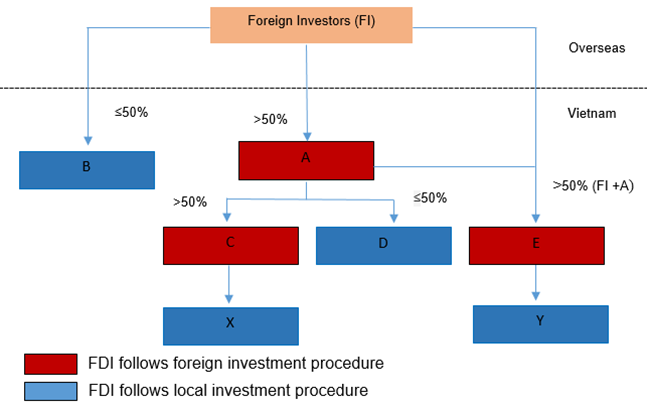
According to the new regulations, the Land Law 2024 distinguishes this subject into Economic Organizations (“EO“) and Economic Organizations with foreign investment capital, while the REBL 2023 uses a common term Economic Organizations with foreign investment capital. Although the names are different, the scope of rights implementation for these entities has been adjusted consistently according to the guidance of the Investment Law:

  • Economic organizations with foreign investment capital subject to conditions and investment procedures applicable to foreign investors (abbreviated as “EO following foreign investment procedures“): enjoy rights and fulfill obligations regarding land as well as conduct real estate business with limited scope (See A, C, and E in Table B below).
  • The remaining economic organizations with foreign investment capital (abbreviated as “EO following domestic investment procedures“): enjoy rights and fulfill obligations regarding land as well as conduct real estate business with a broad scope like domestic organizations and individuals (See B, D, X, and Y in Table B below).

The reference to the Investment Law makes the provisions of this law and the REBL 2023, Land Law 2024 more consistent.

Specifically, the change in grouping enterprises with foreign investment capital can be visualized as follows:

Table A: Law on Real Estate 2014 and Land Law 2013


Table B: Law on Real Estate 2023 and Land Law 2024

With these new regulations, some EOs with foreign investment capital will be subject to conditions and procedures specified for domestic investors which are much more open than those for enterprises with foreign investment capital. For example, the scope of real estate business for company A with 70% foreign capital and company B with 5% foreign capital is the same according to the REBL 2014. Accordingly, companies A and B are not allowed to purchase, rent-to-buy houses and construction works for the purpose of sale, lease, or rent-to-buy. However, according to the new provisions of the REBL 2023, company B will be allowed to exercise the right to purchase, rent-to-buy houses and construction works for sale, lease, or rent-to-buy.

Although the unification of terminology between the REBL 2023 and the Investment Law 2020 through the REBL 2023’s reference to the Investment Law 2020 is a new provision, the classification of enterprises with foreign investment capital as mentioned above is not a new provision of the Investment Law 2020 but is a provision inherited from the Investment Law 2014. Nevertheless, during the implementation of the Investment Law 2014, we have seen many cases where enterprises with foreign investment capital with foreign capital ratios below 50% were not applied investment conditions and procedures like domestic investors. Therefore, as with the practical implementation of the Investment Law 2014 and the Investment Law 2020, we need to wait for further guidance from the Government and monitor the actual application of the law by state management agencies.

The scope of real estate business for both domestic and foreign organizations is expanded

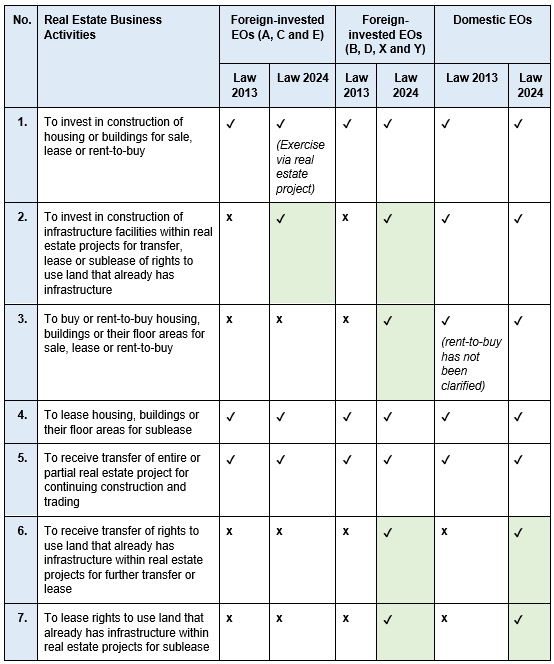
Summarizing these new regulations, we can see the changes in the table below:


According to the table above, the right to conduct business in land use rights with technical infrastructure in real estate projects (receiving transfers for transfer, lease; leasing for sublease) is a completely new right, applicable to domestic EOs. Meanwhile, foreign EOs will be allowed to invest in constructing technical infrastructure in real estate projects to transfer, lease, sublease land use rights with technical infrastructure, which was previously reserved only for domestic EOs.

With the expanded scope of real estate business activities, EOs following domestic investment procedures have more options in terms of forms and real estate products. Accordingly, foreign investors can choose different M&A structures to access suitable real estate projects, for example:

(i) To establish Company A themselves to carry out real estate business activities applicable to EOs following foreign investment procedures;

(ii) To establish Companies A, C, and X themselves; use X to implement real estate projects according to the broad scope applicable to EOs following domestic investment procedures;

(iii) To cooperate with domestic investors to establish Company B to be able to immediately implement real estate projects according to the broad scope applicable to EOs following domestic investment procedures.

Thus, the provisions of the new law will significantly affect the investment structure, the way investors acquire land, and the financial aspects of real estate projects. Understanding the new regulations and following how these regulations are applied in practice will help real estate businesses better prepare in planning, managing, and implementing projects.

[1] Article 5.7, Land Law 2013

Download the PDF version of this article here.

(VN) Expanding the Business Scope of Enterprises with Foreign Investment Capital

On August 1, 2024, the three most pivotal legal documents within Vietnam’s real estate legal framework, namely the Land Law 2024, the Real Estate Business Law (“REB Law“) 2023, and the Housing Law 2023, came into effect. Together with certain related provisions in the Credit Institutions Law 2024, these laws are set to significantly impact the real estate market in Vietnam.

Vilasia, in collaboration with The Saigon Times, is pleased to present a series of analytical articles by Vilasia’s Nhung Nguyen on the most noteworthy new regulations in these four legal documents. The series will focus on six main topics:

(i) Methods for determining land rent and land use fees;
(ii) Conditions and procedures for transferring real estate projects;
(iii) Specific regulations on commercial housing projects;
(iv) Specific regulations on industrial park projects;
(v) Implementation of projects in the form of subdividing land lots for sale; and
(vi) Expansion of business scope for enterprises with foreign investment.

Below is the last in the series entitled “Expanding the business scope of enterprises with foreign investment capital”, originally published in Vietnamese in The Saigon Times on August 29, 2024. The digital version is available here.

Bai 6

(EN) Implementation of Projects in the Form of Subdividing Land Lots for Sale

The Vietnamese version is available here.

Click here to download the PDF version.

On August 1, 2024, the three most pivotal legal documents within Vietnam’s real estate legal framework, namely the Land Law 2024, the Real Estate Business Law (“REB Law“) 2023, and the Housing Law 2023, came into effect. Together with certain related provisions in the Credit Institutions Law 2024, these laws are set to significantly impact the real estate market in Vietnam.

Vilasia, in collaboration with The Saigon Times, is pleased to present a series of analytical articles by Vilasia’s Nhung Nguyen on the most noteworthy new regulations in these four legal documents. The series will focus on six main topics:

(i) Methods for determining land rent and land use fees;
(ii) Conditions and procedures for transferring real estate projects;
(iii) Specific regulations on commercial housing projects;
(iv) Specific regulations on industrial park projects;
(v) Implementation of projects in the form of subdividing land lots for sale; and
(vi) Expansion of business scope for enterprises with foreign investment.

Below is the fifth in the series entitled “Implementation of projects in the form of subdividing land lots for sale”, originally published in Vietnamese in The Saigon Times on August 22, 2024. The digital version is available here.

____________________________

Is land subdivision and plot sales being tightened?

First, it is necessary to distinguish between subdividing land lots for sale and other forms of business involving land with technical infrastructure newly stipulated in the REB Law 2023. Accordingly, subdividing land lots for sale is a form of transferring land use rights with technical infrastructure to individuals for self-construction of housing, while in other forms, the transferees are organizations, and the purpose can be housing construction or implementation of other investment projects.

The listing of additional areas where subdividing land lots for sale are not allowed in the Housing Law 2023 and Real Estate Business Law 2023 suggests that these activities will be more tightly controlled. However, upon closer comparison, some positive points can be seen as follows:

Clarification of areas where subdividing land lots for sale are not allowed

Regarding areas where subdividing land lots for sale are not allowed, the new Law adds areas such as wards, districts, and cities directly under type I, II, and III urban areas, while currently it only applies to wards in special type and type I urban areas directly under central authority (before February 2021, only special type in urban areas were prohibited from l subdividing land lots for sale).

According to statistics from the Ministry of Construction in December 2023, about 105 cities and towns are immediately included in the list of areas where subdividing land lots for sale are not allowed, an increase of 81 cities and towns compared to current regulations.

However, it should be noted that areas where subdividing land lots for sale are not allowed according to Decree 43/2013/ND-CP (amended by Decree 148/2020/ND-CP), Decree 11/2013/ND-CP (amended by Decree 35/2023/ND-CP), and Joint Circular 20/2013/TTLT-BXD-BNV also list additional cases such as:

  • Areas with high requirements for architectural landscapes;
  • Central areas and areas surrounding architectural landmark buildings in urban areas;
  • Frontages of roads at regional level or higher; and
  • Main landscape routes in urban areas.

Thus, with the current regulations, investors cannot immediately determine the areas where subdividing land lots for sale are not allowed, but must depend entirely on the determination of the state management agency for construction. Therefore, there are many cases where the entire proposed project or some areas of the proposed project do not belong to the wards in special type in urban areas or type I urban areas directly under central authority but will also not be allowed for subdividing land lots for sale due to falling under the remaining cases.

With the new provisions of the Housing Law 2023 and Real Estate Business Law 2023, areas where subdividing land lots for sale are not allowed have been clearly and specifically listed, making it easier for investors and local construction management agencies to determine whether their project area is in a location where subdividing land lots for sale are not allowed. However, it should be noted that the specific determination of each area allowed for subdividing land lots for sale will be regulated by each locality.

Thus, although more areas are listed as prohibited for subdividing land lots for sale, from a positive perspective, the clarity and detail of the new regulations will create more favorable conditions for investors and state management agencies in the process of implementing administrative procedures.

Legalizing local authority

Not only clarifying the areas, the REB Law 2023 has legalized administrative procedures, clearly stating that the authority to check compliance with conditions and confirm eligibility belongs to the “provincial-level state management agency for real estate business on construction” and the time limit for this procedure is 15 days from the date of receiving the notification from the investor.

Although this regulation still needs to be detailed by the Government, the legalization of regulations on local authority has great significance for investors, while compared to the regulations before Decree 35/2023/ND-CP took effect (June 20, 2023), the provincial People’s Committee needed to submit and seek opinions from the Ministry of Construction before issuing a confirmation document for investors to carry out subdividing land lots for sale in a specific area. To implement this procedure, the provincial People’s Committee needed to prepare a detailed explanatory dossier to send to the Ministry of Construction for opinions on the proposed project, leading to additional effort and time in implementing administrative procedures.

In summary, subdividing land lots for sale activities will be more tightly controlled and limited, but on the other hand, these limitations as well as administrative procedures are more clearly legalized and simplified, which will certainly create more favorable conditions for investors in this type of real estate business in permitted areas.

Download the PDF version of this article here.

(VN) Implementation of Projects in the Form of Subdividing Land Lots for Sale

On August 1, 2024, the three most pivotal legal documents within Vietnam’s real estate legal framework, namely the Land Law 2024, the Real Estate Business Law (“REB Law“) 2023, and the Housing Law 2023, came into effect. Together with certain related provisions in the Credit Institutions Law 2024, these laws are set to significantly impact the real estate market in Vietnam.

Vilasia, in collaboration with The Saigon Times, is pleased to present a series of analytical articles by Vilasia’s Nhung Nguyen on the most noteworthy new regulations in these four legal documents. The series will focus on six main topics:

(i) Methods for determining land rent and land use fees;
(ii) Conditions and procedures for transferring real estate projects;
(iii) Specific regulations on commercial housing projects;
(iv) Specific regulations on industrial park projects;
(v) Implementation of projects in the form of subdividing land lots for sale; and
(vi) Expansion of business scope for enterprises with foreign investment.

Below is the fifth in the series entitled “Implementation of projects in the form of subdividing land lots for sale”, originally published in Vietnamese in The Saigon Times on August 22, 2024. The digital version is available here.

Bai 5

(EN) Specific Regulations on Industrial Park Projects

The Vietnamese version is available here.

Click here to download the PDF version.

On August 1, 2024, the three most pivotal legal documents within Vietnam’s real estate legal framework, namely the Land Law 2024, the Real Estate Business Law (“REB Law“) 2023, and the Housing Law 2023, came into effect. Together with certain related provisions in the Credit Institutions Law 2024, these laws are set to significantly impact the real estate market in Vietnam.

Vilasia, in collaboration with The Saigon Times, is pleased to present a series of analytical articles by Vilasia’s Nhung Nguyen on the most noteworthy new regulations in these four legal documents. The series will focus on six main topics:

(i) Methods for determining land rent and land use fees;
(ii) Conditions and procedures for transferring real estate projects;
(iii) Specific regulations on commercial housing projects;
(iv) Specific regulations on industrial park projects;
(v) Implementation of projects in the form of subdividing land lots for sale; and
(vi) Expansion of business scope for enterprises with foreign investment.

Below is the fourth in the series entitled “Specific regulations on industrial park projects”, originally published in Vietnamese in The Saigon Times on August 15, 2024. The digital version is available here.

____________________________

Industrial park projects are subject to State land acquisition and allocation/lease

The Land Law 2013 provides regulations on cases of land use right auctions and cases without land use right auctions, causing investors and competent State agencies to have to cross-reference many other legal documents such as the Bidding Law, Investment Law, specialized laws regulating each type of project, etc., to conclude whether a project is subject to auction, bidding, or neither. To address this situation, the Land Law 2024 has specifically stipulated the cases, conditions, and procedures for applying each form of state land allocation and lease:

  • Without land use right auction, without bidding to select investors to implement projects using land (Article 124);
  • Via land use right auction (Article 125);
  • Via bidding to select investors to implement investment projects using land (Article 126);
  • Via agreement on land use rights with landowners and land use by own investors.

Among the above forms, the form of State land allocation/lease without auction/bidding is regulated in the direction of detailing cases and conditions to be met to limit the cases applying this form; and instead, the form of auction/bidding to increase budget revenue and agreement on land use rights/land use by investors to balance benefits between investors and landowners will be prioritized.

Specifically for investment projects and construction of industrial park infrastructure, the Land Law 2024 has clarified that industrial park projects implemented with private capital will be subject to land allocation and lease without auction or bidding (specifically, they fall under the case of projects being leased land with exemption from land rent due to implementation in investment incentive areas such as industrial parks[1]). For investors, this clear regulation is of great significance as industrial park projects with typically very large land use areas will still need the State to carry out compensation, support, and resettlement work, as it would be difficult to negotiate with a large number of people with land use rights. At the same time, not having to go through auction/bidding procedures will significantly reduce time and costs for investors to prepare and implement these procedures. For state agencies, this regulation will avoid controversy as well as avoid the need to explain and justify this issue during the appraisal process and monitoring of industrial park project implementation due to related regulations being scattered across various legal documents as is currently the case.

Economic organizations with foreign investment capital are allowed to receive land use right transfers in Industrial Parks[2]

The Land Law 2013 mentioned this right of land users but only granted it to overseas Vietnamese, while enterprises with foreign investment capital were only allowed to receive investment capital transfers in the form of land use right value, provided that the land was allocated with land use fees or leased with one-time rent payment, and the value of land use rights had been capitalized into the enterprise’s capital.

Thus, until now, this is the only case where enterprises with foreign investment capital have the right to receive land use right transfers from other land users, whereas previously they could only receive land from the State in the form of land allocation or land lease. This exception is due to the unique nature of industrial park projects: industrial park projects are planned according to the Sector Planning (Vietnam Industrial Park Development Planning) and established according to a strict process, with the participation of many levels of management and many relevant ministries and sectors from the step of approving/deciding on investment policies. During this process, state agencies have carefully considered issues of security, national defense, planning, environment, land, etc. Additionally, each industrial park is established with its own purpose and development orientation, synchronized in technical infrastructure, and investors operating in the industrial park must commit to ensuring issues of construction, environment, fire prevention and fighting, etc., so the exercise of rights by foreign investors when receiving land use right transfers in this area will be quite tightly controlled.

However, it should be understood that the transfer and receipt of land use right transfers can only be carried out with land leased by the state in the form of one-time rent payment for the entire lease period – consistent with the rights of land users according to each form of land allocation and lease from the state.

Although not a new point, another exception applied to industrial park projects is that for the form of annual land rent payment, industrial park infrastructure business enterprises are allowed to sublease land use rights where the sublessee is still granted a Land Use Right Certificate.

With the above-mentioned specificities, it can be seen that industrial park projects are encouraged in legal perspective in the process of establishment and development. In particular, with the right to receive land use right transfers in industrial parks, foreign investors will have more options to access land funds and may avoid having to implement complex M&A forms with potential risks such as project transfer or capital transfer in target companies.

New regulations on compensation, support, and resettlement

With the characteristic of concentrated industrial development, industrial park projects typically require very large land areas, up to tens or hundreds of hectares, with some projects needing up to thousands of hectares of land. Therefore, compensation, support, and resettlement are always the most burdensome, complex, time-consuming, and problematic tasks in the development of industrial park projects.

The Land Law 2024 particularly has many adjustments aimed at resolving obstacles and quickly promoting compensation, resettlement, and site clearance work, and accordingly, industrial park projects are expected to benefit from these legal changes. Some adjustments are summarized as follows:

  • Along with the abolition of the land price framework and the issuance of annual land price tables for each locality, land compensation prices will be closer to market prices and are expected to increase over time and accurately reflect the market of each locality. Benefiting from this policy, compensation prices calculated based on specific land prices at the time of approving the compensation, support, and resettlement plan will provide more market-based compensation for people whose land is acquired.
  • Land users can not only be compensated with land of the same use purpose but also with land of different use purposes from the acquired land or with housing if the locality has land fund conditions. Land users, when desired, will be compensated in cash without having to wait until the compensation land fund is exhausted.
  • In cases where people whose land is acquired, property owners do not accept compensation and support money, this amount will be deposited in commercial banks with non-term interest rates, and this interest will be paid to the people whose land is acquired, property owners[3].
  • The conditions for technical infrastructure and social infrastructure of resettlement areas are clearly and strictly regulated in the direction of ensuring better conditions for resettled people instead of general regulations as currently. Accordingly, the minimum technical infrastructure must meet new rural or corresponding urban standards for the area, in which roads ensure connection with surrounding areas, lighting and domestic electricity, water supply and drainage systems, communication, environmental treatment; social infrastructure must ensure access to health, education, cultural, sports, market, commercial, service, entertainment, and cemetery services[4].

The Land Law 2024 also adds provisions on the location of resettlement projects and resettlement areas in order of priority: same commune, same district if not possible in the same commune, different district if not possible in the same district; and finally prioritizing locations with favorable positions to form resettlement areas.

  • Regarding the process of implementing compensation, resettlement, and land acquisition, the Land Law 2024 has legalized regulations on the timing of issuing Land Acquisition Decisions after the approval of compensation, support, and resettlement plans; for cases requiring resettlement arrangements, land acquisition decisions can only be issued after residential land and housing for resettlement have been completed for people whose land is acquired. At the same time, there are provisions for some cases where land can be acquired if agreed by the person whose land is acquired and who has received compensation money to arrange their own accommodation or has been temporarily resettled[5].

All of the above adjustments in the Land Law 2024 demonstrate the State’s efforts to remove obstacles and quickly promote site clearance for project implementation and will be of utmost importance in the implementation of industrial park projects. However, due to many new policies and regulations being issued, it will take time to see the actual implementation effectiveness.

Housing for workers

While the Housing Law 2014 considered housing for workers in industrial parks as a type of social housing and designed a common policy for all types of social housing, including worker housing, the Housing Law 2023 has designed this content as a separate section in social housing development policy, referred to by the specific term “Worker accommodation in industrial parks”[6].

Accordingly, worker housing must meet specific requirements, including area, synchronization of technical infrastructure systems, social infrastructure, ensuring environmental issues, while being separate from the production area in the industrial park and ensuring security and safety for the residential area. When these requirements are met in practice, the living standards of workers in industrial parks will certainly be improved, thereby attracting labor sources from local areas as well as surrounding areas to work in industrial parks. Notably, workers using this type of worker housing can only rent or sublease without the option to buy or rent-to-buy – a form that helps workers significantly reduce their financial burden but conversely pushes this burden onto the investors developing worker housing projects.

For investors, although they cannot quickly recover capital from building worker housing through rent or rent-to-buy forms, the Housing Law 2023 has added new incentives alongside traditional incentives on land use fees, land rent, and taxes. Specifically, the cost of investing in technical infrastructure and social infrastructure is included in the investment cost of industrial park infrastructure, while the cost of investing in construction or the cost of renting houses for workers to sublease is considered as a deductible expense when determining taxable corporate income[7].

Additionally, industrial park infrastructure business enterprises are required to determine the demand for worker housing rentals, while also preparing and submitting plans as well as investing in infrastructure construction for worker housing associated with that industrial park. Conversely, industrial park infrastructure business enterprises can transfer land funds to manufacturing enterprises in the industrial park in the form of land lease – a form of receiving land use rights that is very clearly and specifically regulated, aimed at reducing the financial burden for construction investors if annual land rent is paid, whereas previously, the Land Law 2013 did not specify this form, leading to industrial park infrastructure business enterprises being in a state of confusion and perplexity when wanting to transfer the right to develop social housing projects for workers, especially for enterprises with foreign investment capital.

This is both an opportunity to develop sustainable industrial parks and a heavier responsibility for industrial park infrastructure business enterprises.

[1] Article 124.1, Article 157.1.a Land Law 2024

[2] Article 28 Land Law 2024

[3] Article 94.3 Land Law 2024

[4] Article 110 Land Law 2024

[5] Article 91.6, Article 87.5 Land Law 2024

[6] Section 3 Chapter VI and Article 2.8 Housing Law 2023

[7] Article 98 Housing Law 2023

Download the PDF version of this article here.
(VN) Specific Regulations on Industrial Park Projects

On August 1, 2024, the three most pivotal legal documents within Vietnam’s real estate legal framework, namely the Land Law 2024, the Real Estate Business Law (“REB Law“) 2023, and the Housing Law 2023, came into effect. Together with certain related provisions in the Credit Institutions Law 2024, these laws are set to significantly impact the real estate market in Vietnam.

Vilasia, in collaboration with The Saigon Times, is pleased to present a series of analytical articles by Vilasia’s Nhung Nguyen on the most noteworthy new regulations in these four legal documents. The series will focus on six main topics:

(i) Methods for determining land rent and land use fees;
(ii) Conditions and procedures for transferring real estate projects;
(iii) Specific regulations on commercial housing projects;
(iv) Specific regulations on industrial park projects;
(v) Implementation of projects in the form of subdividing land lots for sale; and
(vi) Expansion of business scope for enterprises with foreign investment.

Below is the fourth in the series entitled “Specific regulations on industrial park projects”, originally published in Vietnamese in The Saigon Times on August 15, 2024. The digital version is available here.

Bai 4

Contact Us
Email Us

For detailed inquiries, please email us at info@vil.asia.

Call Us

For quick questions or to arrange a meeting, feel free to call us at: (+84) 286 270 8696.

Meet Us in Person

Please visit us at:

Ho Chi Minh City

Aqua 1, Vinhomes Golden River, 2 Ton Duc Thang, Sai Gon Ward

Hanoi

11th Floor, Heritage West Lake Building, 677 Lac Long Quan, Tay Ho Ward